New builds
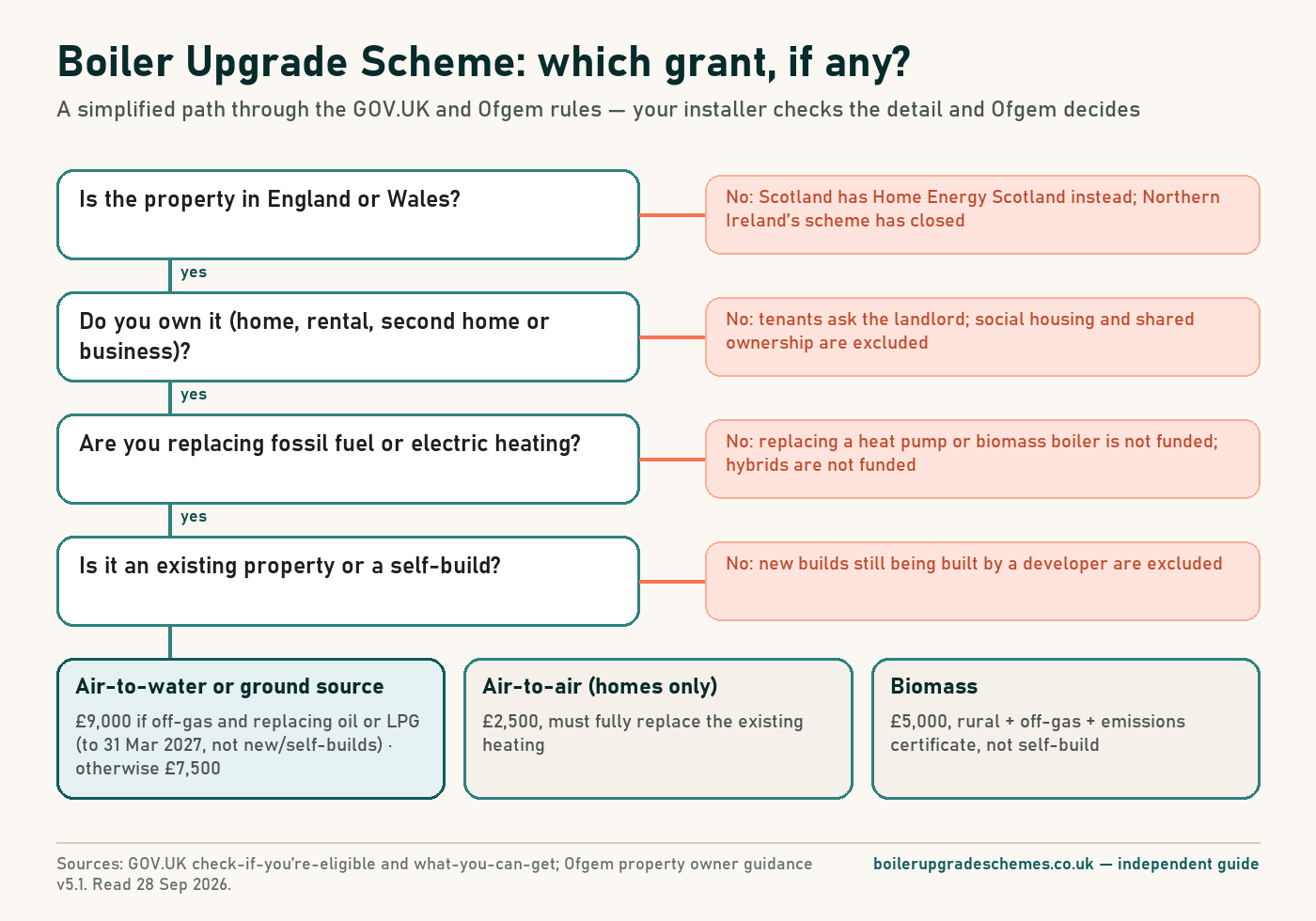
GOV.UK says “most new build properties” cannot get a grant, and draws the line in two places:
- Still being built by a developer: not eligible.
- Finished, and you have moved in: “If you move into a finished new build with a fossil fuel boiler, you may be able to get a grant for a heat pump under the scheme.” The installer will need to show the property meets the rules.
New builds are also outside Ofgem’s definition of an off-gas property for the £9,000 band, so a qualifying new build gets £7,500. Energy-saving materials installed during construction of a new dwelling are dealt with under separate VAT rules from the retrofit relief — see VAT on heat pumps.
Self-builds
A self-build is eligible, according to GOV.UK, if you or the original owner built it yourself or paid a builder to build it, and it has never been owned by a business or organisation. Ofgem’s Appendix 1 adds that the rules are designed to support homes built by, or for, the people who will live in them, rather than homes built by companies; properties owned by a company while being built do not meet the definition, and a self-build cannot form part of an excluded property development.
| Self-build | Position |
|---|---|
| Air source or ground source heat pump | £7,500 |
| Off-gas uplift to £9,000 | Not available — Ofgem guidance 3.13 |
| Air-to-air heat pump | £2,500 if it meets the residential rules |
| Biomass boiler | Not eligible in self-builds |
| No previous heating system | Acceptable — self-builds are the main exception to the replacement rule |
Expect to provide more evidence than for an existing home. Ofgem lists the kinds of documents it may ask for, such as confirmation of a self-build VAT exemption, a self-build loan or mortgage, or self-build insurance. If the property has no confirmed address yet, Ofgem will accept a temporary one. Of all grants paid so far, 13% replaced no previous system — largely self-builds.
Second homes and holiday lets
GOV.UK’s ownership test names second homes explicitly: you must own the property, “including if it’s a business, a second home, or a property you rent out”. A holiday let you own therefore passes the ownership test, subject to the other rules, and there is one grant per property. Practical points: you will need to be reachable for Ofgem’s consent email within 14 days, and to allow access if the installation is selected for an audit. If the second home is off the gas grid and heated by oil or LPG, it may qualify for £9,000 — see the off-gas grant.
Landlords
Private landlords can use the scheme for a property they rent out. Ofgem expects you to have told your tenant about the installation, and asks you to confirm that as part of consent. The tenant cannot apply in your place. Because a heat pump changes how the heating is used, a short handover for the tenant on the controls is worth arranging with the installer.
Social housing is different: properties classed as social housing, including shared ownership, are not eligible.
Other property types
- Business premises: eligible for heat pumps and biomass within the capacity limits (45kWth for a single system); not for air-to-air. 99.4% of grants paid have been domestic.
- Churches and park homes: Ofgem says they may be eligible, subject to the wider rules.
- Flats: eligible if you own the flat and the installation meets the rules; a shared ground loop has a 300kWth limit. In England, planning limits differ for blocks of flats — see planning permission.
- Properties already funded for a heat pump or biomass boiler: usually not eligible again.
For everything else, the full eligibility guide has the complete rules and a quick checker.
Mix-ups we see
“My developer said the house qualifies for the grant.”
While the developer is still building it, it does not — new builds under construction by a developer are excluded. Once it is finished and you own it, a home with a fossil fuel boiler may qualify for a heat pump grant; ask the installer to check the specific rules for your property.
“A self-build gets everything a normal home gets.”
Nearly. A qualifying self-build can get £7,500 for a heat pump, but not the £9,000 off-gas band and not a biomass grant.
The self-build evidence requirements are also heavier, so start collecting documents early.