Four situations, four answers
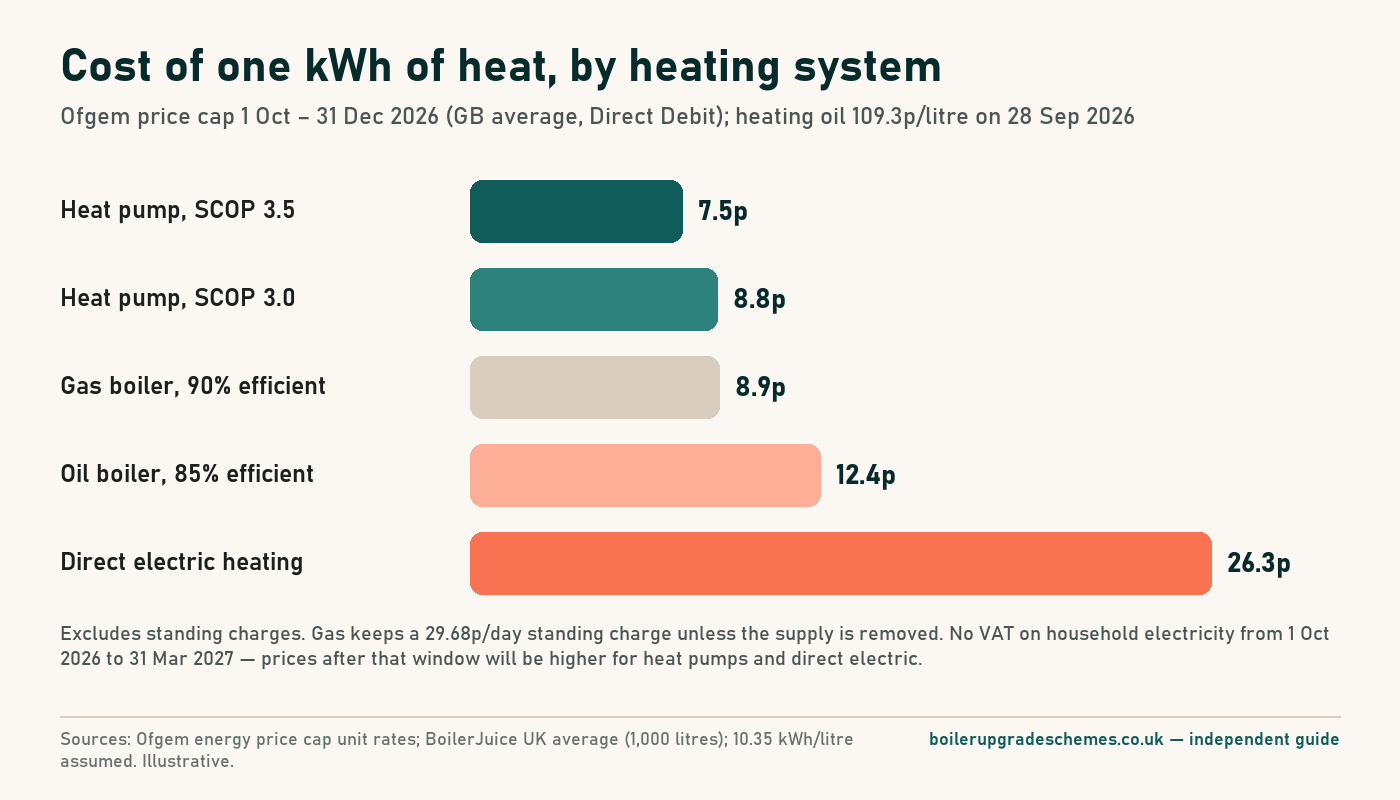
The question “are heat pumps worth it?” has no single answer, because the thing being replaced changes everything. At the 1 October to 31 December 2026 Ofgem cap and today’s oil price, this is how one kWh of heat compares:
| Heating now | Cost per kWh of heat | Heat pump per kWh | Grant | Our verdict |
|---|---|---|---|---|
| Storage or panel heaters | 26.3p | 8.8p | £7,500 | Usually worth it |
| Oil, no gas connection | 12.4p | 8.8p | £9,000 to 31 March 2027 | Usually worth it |
| Gas, boiler near the end of its life | 8.9p | 8.8p | £7,500 | Often worth it |
| Gas, boiler a few years old | 8.9p | 8.8p | £7,500 | Probably wait |
The upfront cost after the grant
The grant exists to deal with the biggest objection — the purchase price. Using the government’s median installed cost for 2026 Q2 (£12,908 for air source), the balance after a £7,500 grant is £5,408, and £3,908 after £9,000. The Energy Saving Trust gives around £12,000 as a typical installation cost before any grant.
The fair comparison is not “heat pump versus nothing” but “heat pump versus the boiler you would otherwise buy”. If your boiler has years left, the whole balance is extra spending. If it needs replacing soon, only the difference between the two quotes is. That is why age of boiler matters so much in the table above — and why we suggest getting a boiler quote and a heat pump quote for the same house before deciding.
The running cost
For a home using 12,000 kWh of heat a year, the illustrative yearly costs at today’s prices are about £1,053 for a heat pump at a seasonal efficiency of 3 (£902 at 3.5), £1,063 for a 90% gas boiler plus a £108 gas standing charge if you keep the supply, £1,491 for oil and £3,158 for direct electric heating.
Two things flatter the heat pump in those numbers and one flatters gas. Household electricity carries no VAT from 1 October 2026 to 31 March 2027; after that, electricity will cost more. On the other side, many heat pump owners move to a time-of-use tariff designed for heat pumps, which our model does not assume. And the gas standing charge only disappears if you remove the gas supply completely. Run your own figures:
Is it worth it for your home?
No details needed. Change any figure to match your own quote or bills. Results are indicative — an MCS installer’s heat-loss survey and written quote are what count.
£5,408
Payable by you on this quote. The grant is deducted on the quote and invoice — you never receive it as cash.
Default quote = the official median installed cost for 2026 Q2 (DESNZ, published 24 September 2026), which includes the grant value. VAT on installing a heat pump in a home is 0% until 31 March 2027, then 5%.
—
Difference per year at these prices.
Prices: Ofgem cap 1 October to 31 December 2026 — electricity 26.32p/kWh, gas 7.97p/kWh, gas standing charge 29.68p/day (GB average, Direct Debit); heating oil 109.3p/litre (BoilerJuice UK average for 1,000 litres, read 28 September 2026); 10.35 kWh per litre assumed. No VAT on household electricity from 1 October 2026 to 31 March 2027, which flatters heat pumps in this window. LPG prices vary too much to default — use your own bills. Illustrative, not a quote.
When a heat pump is not worth it
We would rather lose a reader than oversell. These are the situations where we would slow down or not bother:
Wait or reconsider if…
- You are on mains gas with a boiler under about half its life, and your main motive is saving money. The running cost is roughly level; the capital is extra.
- You plan to move within a couple of years and have a working boiler.
- There is nowhere suitable for the outdoor unit within the planning rules, or no space for a hot-water cylinder, and no installer has shown you a workable design.
- Every quote you get is well above the official median and none will itemise why.
- You do not own the property, or it is in Scotland or Northern Ireland — this scheme cannot help.
Go ahead with confidence if…
- You heat with storage heaters, panel heaters, oil or LPG.
- Your boiler is failing and you would be paying for a replacement anyway.
- You qualify for £9,000 and can have the installer apply by 31 March 2027.
- A proper heat-loss survey shows a sensible design, and the installer checks out on the MCS register.
- You care about cutting the carbon from your heating as well as the bill.
What makes it more worth it
- Good design. Low flow temperatures and correctly sized radiators give a better seasonal efficiency. Ask the installer for the design SCOP and flow temperature in writing.
- Insulation. No longer required for the grant, but every kWh you do not need is a kWh you do not buy.
- The right tariff. Heat-pump tariffs that charge less at certain times can cut running costs significantly, according to the Energy Saving Trust.
- Removing the gas supply. If nothing else uses gas, capping it saves the standing charge — about £108 a year at today’s cap.
Is the Boiler Upgrade Scheme itself worth it?
If you are going to install a heat pump, yes — there is no reason not to use it. The grant is deducted upfront, you do not handle the money, and the process mostly sits with the installer. The only real costs are the constraints: an MCS-certified installer, full replacement of the old system, and the voucher deadlines. Weigh the heat pump; the grant is the easy part. More in heat pump vs gas boiler, heat pump myths and who is eligible.
The objections worth taking seriously
“It won’t keep my house warm.”
Evidence from the government-funded Electrification of Heat trial, which installed 742 heat pumps across a broad range of homes, found no property type or architectural era that is unsuitable for a heat pump. Warmth depends on correct sizing: the installer must calculate heat loss room by room and size radiators to match.
A badly designed system will leave rooms cold. That is a design failure, not a technology one — which is why the survey matters.
“It will put my bills up.”
Against gas on a standard tariff, running costs are roughly level (about £1,053 against £1,063 plus the gas standing charge, in our illustrative model). Against oil, LPG or direct electric heating they usually fall. A heat-pump time-of-use tariff tends to improve the heat pump figure.
The Energy Saving Trust says heat pumps on standard tariffs "can cost slightly more to run than new gas or oil boilers". Take that seriously if you are on gas.
“The technology will be better and cheaper in a few years.”
It is already getting cheaper: the median air source installation cost fell 11% in real terms between 2023 Q2 and 2026 Q2. Waiting can make sense if your boiler is young. But the £9,000 off-gas band is due to end for applications after 31 March 2027, and heat pump installation VAT moves to 5% from 1 April 2027.
“I might move in a few years.”
Then the running-cost saving has less time to accumulate, and the decision rests more on the upfront balance after the grant and on whether you would have replaced the boiler anyway. We do not quote a figure for what a heat pump adds to a property’s value, because the evidence for a reliable number is thin.