Who applies: the installer, not you
GOV.UK is unambiguous: “The installer will apply on your behalf on the Ofgem website.” Ofgem’s guidance adds that the scheme is installer-led and you cannot apply yourself. The installer applies for a voucher worth the grant, installs the system, then redeems the voucher; Ofgem pays the installer, and you pay only the balance.
That has three practical consequences. You need an installer before anything else happens. The installer must be certified by the Microgeneration Certification Scheme (MCS) for the technology you are having fitted — since 28 April 2026 MCS is the only certification the regulations accept — and a member of a consumer code approved by the government. And the grant never passes through your hands, which is why the regulations now require it to be deducted upfront.
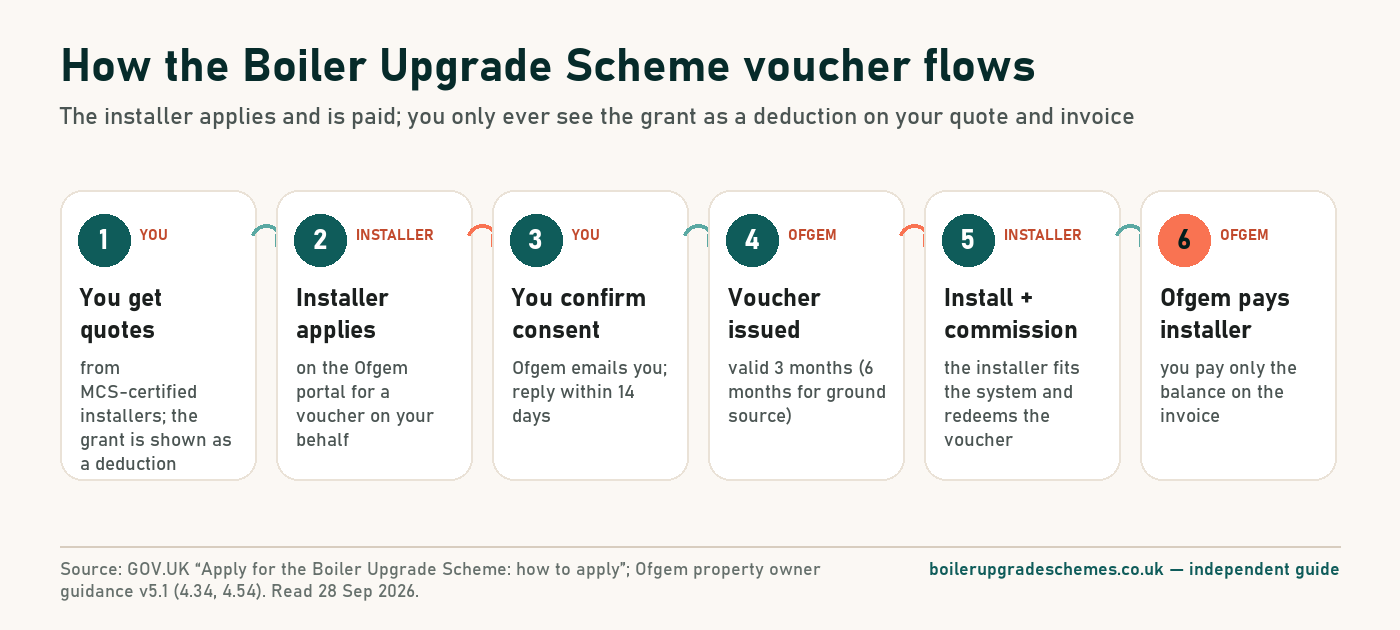
The Boiler Upgrade Scheme application, step by step
Step 1 — Get quotes from MCS-certified installers
Ask at least two installers. Each should survey the property, calculate heat loss room by room, and give you a written quote. Ofgem’s guidance says the quote must show the value of the grant and the remaining amount you will pay after it is deducted. If you are off the gas grid and replacing oil or LPG, the quote should show £9,000 rather than £7,500 for applications made up to 31 March 2027. If the discount is missing, Ofgem asks you to contact its scheme enquiries team before going further.
Step 2 — The installer applies for a voucher
Once you agree to go ahead, the installer submits the voucher application. They gather your name and contact details, the installation address, the chosen system, what it replaces, the quote with the grant deducted, whether the property is connected to the gas grid, and the EPC reference number if there is one. Without a valid EPC they provide other evidence instead — a utility bill dated within three months or a recent fuel receipt, photos of the existing heating system, or an expired EPC.
Step 3 — You confirm consent
Ofgem emails you to confirm the installer is acting for you and to verify your identity. You must provide consent within 14 days of that email or the application may be rejected, and the installer would have to start again. If you cannot use the online route, an assisted telephone or postal route exists and Ofgem allows 28 days for it. A Welsh-language service is available if the installer requests it.
Look out for the email — it can land in a spam folder. Confirming consent does not bind you to the installer.
Step 4 — Ofgem issues the voucher
If the application is approved, Ofgem issues a voucher to the installer. From that point the clock runs: the installer must complete the work, commission the system and redeem the voucher within 3 months for air-to-water heat pumps, air-to-air heat pumps and biomass boilers, or 6 months for ground source heat pumps. If the job cannot be finished in time, the installer may need to withdraw the voucher and apply again, and you would confirm consent again.
GOV.UK’s eligibility page also says the installer must commission and install the heat pump within 120 days of applying. Ofgem’s detailed guidance, which sits alongside the regulations, sets the voucher validity periods above. Ask the installer to put the planned installation date in writing so it sits comfortably inside both.
Step 5 — Installation and commissioning
The installer fits the system to MCS standards and commissions it. You should receive the MCS certificate for the installation and the commissioning and handover documents — keep them, along with the quote, invoice and proof of payment, because Ofgem may ask to see them during checks.
Step 6 — Redemption and payment
The installer redeems the voucher; Ofgem pays them the grant. You pay the balance on your invoice according to your contract. DESNZ statistics show 93,364 redemptions had been paid by the end of August 2026.
Timings at a glance
| Stage | Who acts | Time limit | Source |
|---|---|---|---|
| Consent to the application | You | 14 days from Ofgem’s email (28 days on the assisted route) | Ofgem v5.1 |
| Install, commission and redeem — air-to-water, air-to-air, biomass | Installer | 3 months from voucher approval | Ofgem v5.1, 4.54 |
| Install, commission and redeem — ground source | Installer | 6 months from voucher approval | Ofgem v5.1, 4.54 |
| Retrospective application after commissioning | Installer | Within 120 days of commissioning | Ofgem v5.1, 4.30 |
| Request a review of a decision | Installer, for you | Within 28 days of the decision notice | Ofgem v5.1, 1.05 |
| Higher £9,000 band | Installer | Applications properly made 21 July 2026 to 31 March 2027 | Ofgem v5.1, 3.12 |
Checks, audits and MCS contact
GOV.UK warns that Ofgem might contact you by phone or visit to check the installation, and that MCS might carry out its own checks. That is routine anti-fraud work, not a sign anything is wrong. Ofgem’s guidance asks property owners to allow access if an application is selected for audit, to tell the installer promptly if details such as ownership change, and to keep the key documents. If you are a landlord, you are expected to have told your tenant about the installation.
Be wary of anyone who contacts you claiming to be from the scheme and asks for money: the grant is never paid by you, and Ofgem does not charge property owners.
Retrospective applications
Installers can apply for a voucher after a system has been commissioned, provided the application is properly made within 120 days of commissioning. Ofgem is blunt that this carries additional risk: applying after installation does not guarantee the installation will be eligible or that a grant will be paid. If an installer suggests fitting first and applying later, ask what happens to your bill if the application fails, and get the answer in the contract.
If an application is rejected or a voucher revoked
Only the installer can ask Ofgem to review a decision, and it must do so within 28 days of the notice. If a quote had the grant deducted and the application is then refused, whether the installer can ask you for the deducted amount depends on the contract you agreed. Problems with the installation or the installer’s conduct go to the installer first, then to their consumer code; complaints about how Ofgem ran the scheme go to Ofgem; and complaints about the rules themselves go to DESNZ. Our guide to consumer codes and complaints sets out each route.
Before you ask for quotes
Run the numbers against the official benchmark so you know what a reasonable quote looks like. At the DESNZ median of £12,908 for an air source heat pump, the balance after a £7,500 grant is £5,408; after £9,000 it is £3,908. Your quote will differ — the calculator below lets you plug it in. For the running-cost side, including heat-pump tariffs, see heat pump running costs.
Check a quote against the grant
No details needed. Change any figure to match your own quote or bills. Results are indicative — an MCS installer’s heat-loss survey and written quote are what count.
£5,408
Payable by you on this quote. The grant is deducted on the quote and invoice — you never receive it as cash.
Default quote = the official median installed cost for 2026 Q2 (DESNZ, published 24 September 2026), which includes the grant value. VAT on installing a heat pump in a home is 0% until 31 March 2027, then 5%.
Common worries about the application
“Giving consent locks me in to that installer.”
It does not. Ofgem’s guidance says confirming consent only confirms you agreed to the installer applying on your behalf; it does not commit you to working with them. Your contract with the installer is a separate document — read it before signing.
“If the application fails, I lose the grant and still owe the full price.”
The installer must deduct the grant upfront and cannot ask you for the deducted amount — unless the application is refused or the voucher revoked. What happens then depends on your contract, which is why it is worth asking the installer, in writing, what their terms say before work starts.
That risk is real, and it is highest with retrospective applications made after the system is already in.
“The paperwork will take months.”
Most of it sits with the installer. Your part is replying to Ofgem’s email within 14 days and being available for the survey and the installation. The voucher then gives the installer 3 months (6 for ground source) to finish — plan the installation date with that window in mind.