Heat pump vs gas boiler, side by side
| Air source heat pump | Gas boiler | |
|---|---|---|
| Grant available | £7,500 (Boiler Upgrade Scheme) | None under this scheme |
| Typical installed cost | £12,908 median; £5,408 after the grant | Get a like-for-like quote for your house |
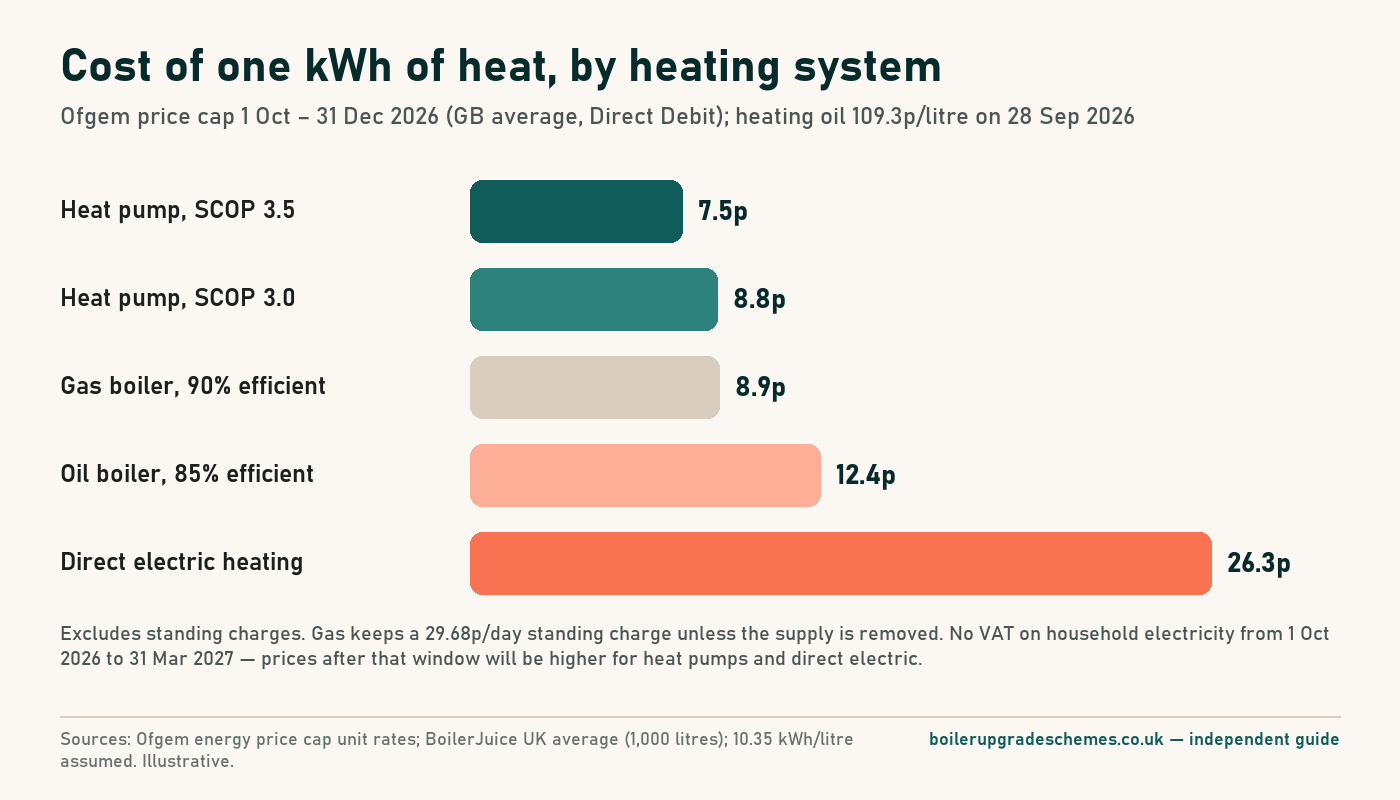
| Cost per kWh of heat | 8.8p at SCOP 3 | 8.9p at 90% efficiency |
| Yearly fuel (example) | £1,053 | £1,063 + £108 standing charge |
| VAT on installation (homes) | 0% until 31 March 2027 | Normally standard rate — a gas boiler is not an energy-saving material |
| Outdoor space | Outdoor unit (up to 1.5 cubic metres for permitted development in England) | Flue only |
| Hot water | Stored in a cylinder | Instant (combi) or cylinder |
| Burns fossil fuel at home | No | Yes |
A note on the VAT row: energy-saving materials such as heat pumps are zero-rated when installed in a home under HMRC Notice 708/6; a gas boiler is not an energy-saving material for that relief, although the notice has narrower reduced-rate rules for some grant-funded heating work for qualifying people. Check the VAT line on any boiler quote you compare against.
Upfront cost
The government’s median installed cost for an air source heat pump was £12,908 in 2026 Q2, leaving £5,408 after the grant. We do not publish a “typical boiler price” because it varies so much with the boiler, the flue and the work needed; the honest comparison is a real quote for each option on your house. Where your boiler needs replacing anyway, the cost of the heat pump that matters is the difference between those two quotes, not the whole £5,408.
If the house is off the gas grid and heated by oil or LPG, the comparison changes completely: the grant is £9,000 for applications made up to 31 March 2027, and the running-cost gap is wide. See the off-gas grant.
Heat pump vs gas boiler running costs
At the 1 October to 31 December 2026 cap, electricity is 26.32p per kWh and gas 7.97p. A heat pump running at a seasonal efficiency of 3 turns that into heat at about 8.8p per kWh; at 3.5, 7.5p. A 90% gas boiler delivers heat at about 8.9p. On a standard tariff the two are essentially level.
Three things tip it. The gas standing charge (£108 a year) disappears if you remove the gas supply. A heat-pump time-of-use tariff can cut heat pump costs further. And design quality moves the seasonal efficiency, which moves everything. Meanwhile, the zero-VAT window on household electricity (1 October 2026 to 31 March 2027) flatters today’s comparison slightly in the heat pump’s favour.
Compare with your gas boiler
No details needed. Change any figure to match your own quote or bills. Results are indicative — an MCS installer’s heat-loss survey and written quote are what count.
—
Difference per year at these prices.
Prices: Ofgem cap 1 October to 31 December 2026 — electricity 26.32p/kWh, gas 7.97p/kWh, gas standing charge 29.68p/day (GB average, Direct Debit); heating oil 109.3p/litre (BoilerJuice UK average for 1,000 litres, read 28 September 2026); 10.35 kWh per litre assumed. No VAT on household electricity from 1 October 2026 to 31 March 2027, which flatters heat pumps in this window. LPG prices vary too much to default — use your own bills. Illustrative, not a quote.
Space, noise and disruption
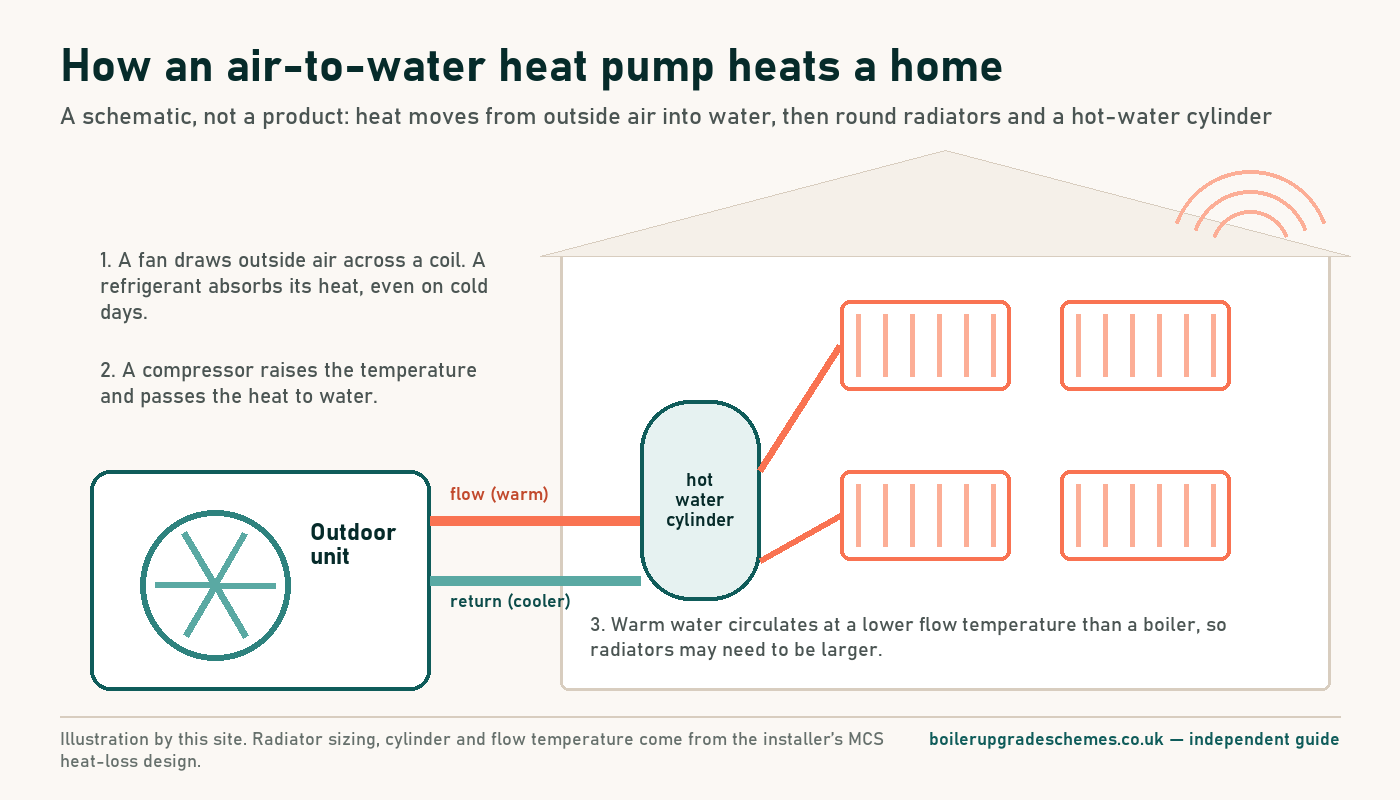
A heat pump needs somewhere outside for the unit and, usually, space inside for a hot-water cylinder — the main practical hurdle in homes with a combi boiler. In England an air source unit on a house is normally permitted development within limits: one unit on a house that is not detached, two on a detached house, up to 1.5 cubic metres, meeting the MCS planning noise standard of 37.0 dB(A) at the neighbour’s assessment position. See planning permission.
Installation generally takes longer than a like-for-like boiler swap, especially if radiators or a cylinder are being added, and ground source adds groundworks. Ask each installer for a written schedule so you know how long you will be without heating or hot water.
How the heat feels
A boiler heats water to a high temperature quickly; a heat pump runs cooler for longer. The result is steadier warmth rather than a burst when the heating clicks on, which suits a house that is kept at an even temperature. People used to turning the heating on for an hour in the evening often need to change habits — the handover should explain the controls.
How to decide
- If your boiler is young and works well, and cost is your priority, wait — and revisit when it needs replacing.
- If it needs replacing, get a heat pump quote and a boiler quote for the same house and compare the difference with the likely running costs.
- Check you are eligible for the grant and that each installer is on the MCS register.
- Read is a heat pump worth it? for the cases where we would not bother.
Boiler loyalists’ questions
“A boiler is simpler — why change something that works?”
If it works well and is not old, that is a reasonable position, and nothing in the scheme forces you to switch. The Boiler Upgrade Scheme is for people who are replacing their heating anyway, or want to stop burning gas.
On pure cost, a young gas boiler is hard to beat. The case for switching early is carbon and future-proofing, not a quick saving.
“Gas boilers are being banned, so I have to switch.”
Existing homes can still keep, repair and replace a gas boiler; the tighter rules people hear about concern new homes. Decide on the merits for your house: running cost, comfort, carbon and the cost of each option after any grant.