Check your situation in thirty seconds
Answer six questions below. The tool applies the same rules as this page and tells you which grant band is likely, or why you would not qualify. Nothing is stored and no contact details are asked for.
Am I eligible for a heat pump grant?
Six quick answers, no contact details. Indicative only — your MCS installer checks eligibility and Ofgem makes the decision.
Likely £7,500
Owner-occupied home in England on mains gas replacing the boiler with an air-to-water heat pump.
Rules: GOV.UK “Apply for the Boiler Upgrade Scheme” and Ofgem’s property owner guidance (v5.1). Grant bands from the notice of grant categories updated 21 July 2026.
The two core tests
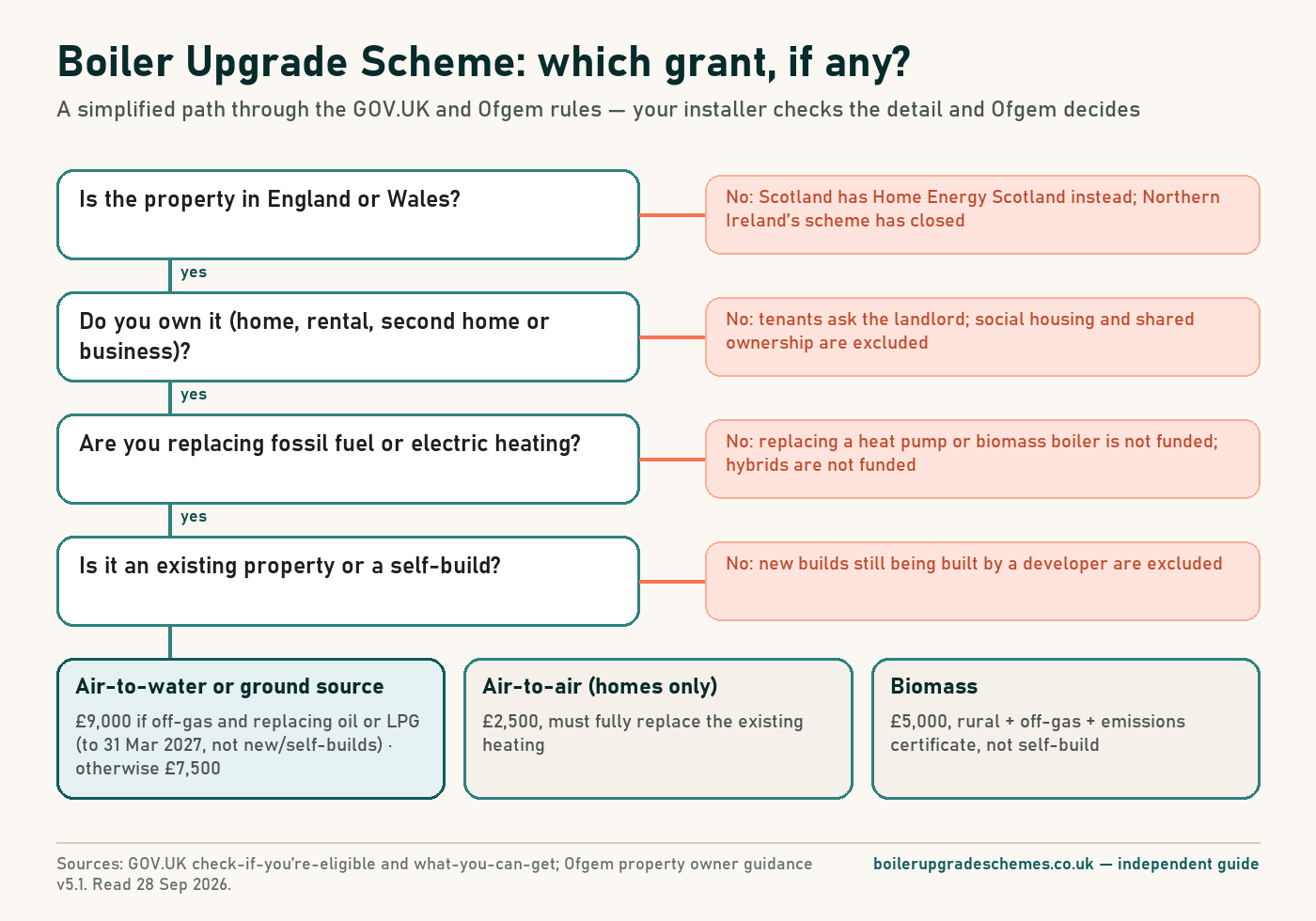
GOV.UK boils Boiler Upgrade Scheme eligibility down to two conditions, and you must meet both:
- You own the property you are applying for — including if it is a business, a second home or a property you rent out.
- You are replacing a fossil fuel heating system — GOV.UK names oil, gas, electric and LPG.
On top of those, the property must be in England or Wales, the installer must be MCS-certified and a member of an approved consumer code, and the system must be within the scheme’s capacity limits: 45kWth for a single system, 70kWth where a heat pump is installed with one or more others, and 300kWth for a shared ground loop. For an ordinary house those limits never come into play.
Who counts as the owner
The grant attaches to ownership, not to who lives there. That produces a few answers people do not expect.
| Your situation | Eligible? | What to know |
|---|---|---|
| Owner-occupier | Yes | The standard case: you own it, you live in it, you choose the installer. |
| Private landlord | Yes | GOV.UK names rental property explicitly. Ofgem expects you to tell your tenant about the installation. |
| Second home or holiday home | Yes | Named on GOV.UK. One grant per property. |
| Business premises | Yes, for heat pumps and biomass | Air-to-air heat pumps are residential only. An organisation not listed on Companies House may need a letter of authority. |
| Tenant | No | Your landlord would need to agree and be the applicant. |
| Social housing, including shared ownership | No | Excluded by Ofgem guidance 3.14. |
| Churches and park homes | Possibly | Ofgem says they may be eligible if they meet the wider rules. |
What you must be replacing
The scheme exists to take fossil fuel heating out of buildings, so the rules about the old system are strict.
- Gas, oil, LPG, coal and electric heating all count. Electric includes storage heaters and panel heaters — they are treated like a fossil system for the purpose of the grant.
- The old system must be fully replaced. Ofgem’s guidance says you cannot keep a fossil fuel system alongside the new one. A gas boiler kept “just in case” disqualifies the job.
- No hybrids. GOV.UK: you cannot get a grant for a hybrid heat pump system.
- No replacing low-carbon heating. If the property already has a heat pump or biomass boiler, the grant cannot pay to replace it — and a property that has had government funding for a heat pump or biomass boiler before is usually excluded.
- No existing system at all? Usually only self-builds qualify in that position. DESNZ statistics show 13% of paid grants replaced no previous system, which is largely that group.
Property types: new builds, self-builds and the rest
“Most new build properties” are excluded, according to GOV.UK, and the exceptions matter:
- A new build still being built by a developer is not eligible.
- A finished new build with a fossil fuel boiler that you have moved into may qualify for a heat pump grant.
- A self-build is eligible if you or the original owner built it, or paid a builder to, and it has never been owned by a business or organisation. Self-builds cannot get the higher £9,000 band or a biomass grant.
The full set of property-type rules, including evidence for self-builds, is in our guide to new builds, self-builds and second homes.
EPC and insulation: no longer conditions
Much of what is written about the scheme online is out of date on this point. Two conditions have gone:
- Insulation. Until 8 May 2024 you needed an EPC with no outstanding recommendations for loft or cavity wall insulation. That condition was removed.
- A valid EPC. The amendment regulations in force from 28 April 2026 removed the requirement for one. If the property has a valid EPC, the installer gives Ofgem its reference number; if not, they provide other evidence — Ofgem lists a utility bill dated within three months or a recent fuel receipt, photos of the existing heating system, and an expired EPC where one exists.
Some official summaries still mention a valid EPC; the regulations and Ofgem’s current guidance are the ones to follow. Insulation remains a good idea for running costs and comfort, and Ofgem suggests discussing it with the installer at design stage.
Which grant band you get
Being eligible is one question; the amount is another. For an air-to-water or ground source heat pump the grant is £7,500, rising to £9,000 if both of these are true, for applications properly made from 21 July 2026 up to 31 March 2027:
- The property is off the gas grid — not fuelled by mains gas (a capped or clamped meter still counts as gas), with no gas meter point on record, not on a heat network and not a new build.
- The system being replaced is fuelled by oil or LPG.
An off-gas property on electric heating, coal or a fossil fuel hybrid gets £7,500. Air-to-air heat pumps get £2,500 in any eligible home; biomass boilers get £5,000 but only in rural, off-gas properties with an emissions certificate. See all grant amounts or the detail on the off-gas grant.
England and Wales only
If the property is in Scotland, the Boiler Upgrade Scheme does not apply; Home Energy Scotland offers its own £7,500 grant with an optional interest-free loan of up to £7,500. In Northern Ireland, GOV.UK says the boiler replacement scheme has closed. More in Scotland, Wales and Northern Ireland.
What the installer will ask for
You do not fill in any forms yourself. To make the application, Ofgem’s guidance says the installer gathers:
- your name, contact details and the installation address;
- the system chosen and the type of system being replaced;
- the quote, showing the grant deducted upfront;
- the EPC reference number, where there is one, or the alternative evidence above;
- whether the property is connected to the gas grid — and for the higher band, evidence that it is off-gas, such as recent fuel bills or photos of the oil tank or LPG bottles.
Ofgem then emails you to confirm you consented to the application — reply within 14 days. How to apply walks through what happens next. If the tool above says you are likely eligible, the practical next step is quotes from MCS-certified installers, who will confirm eligibility in writing before applying; you can check each one using our MCS installer checklist and compare their price with our air source heat pump cost after the grant.