The official median: £12,908
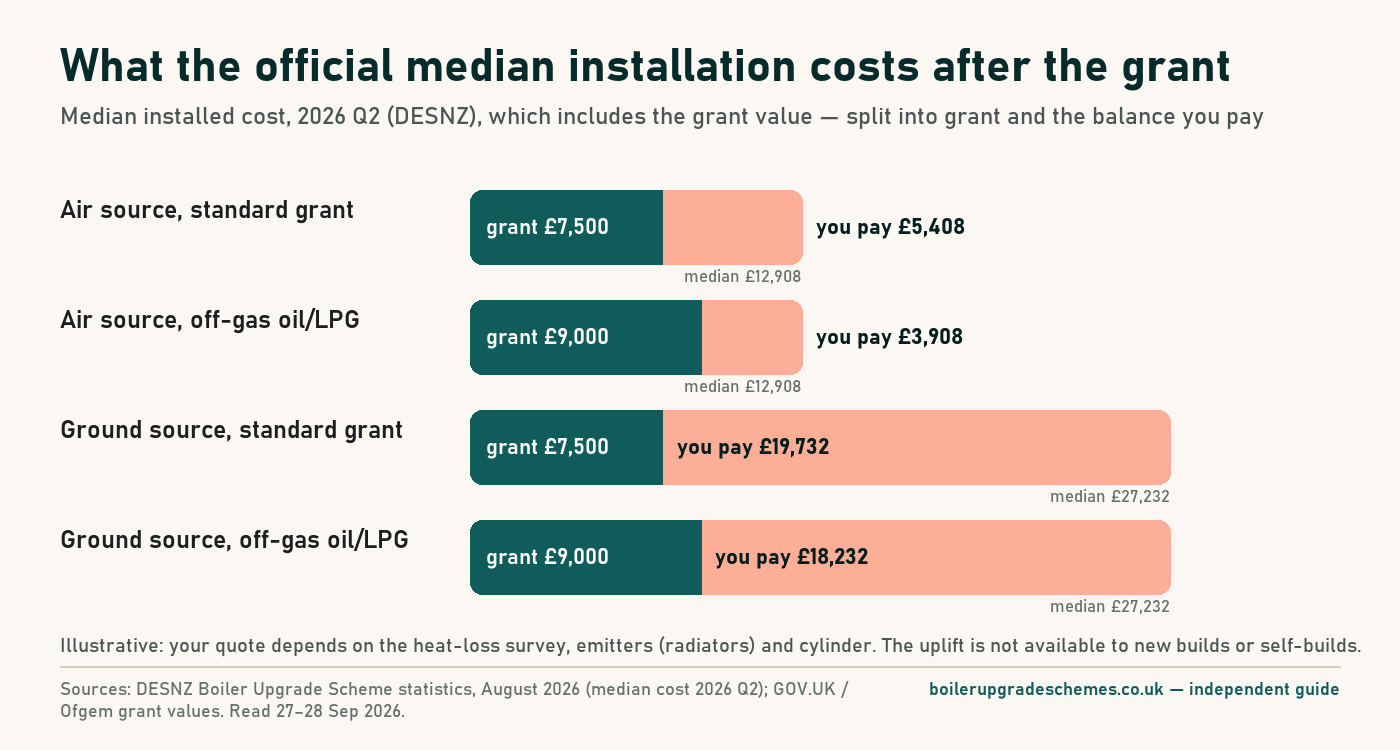
Every grant-funded installation is reported to Ofgem with its cost, and the Department for Energy Security and Net Zero publishes the median each quarter. In 2026 Q2 the median installed cost of an air source heat pump under the scheme was £12,908. That figure includes the value of the grant — it is the full price of the job before the £7,500 comes off.
It has been falling. The same median was £14,545 in 2023 Q2, and DESNZ says the 2026 figure is 11% lower in real terms. The Energy Saving Trust, which advises the government, says the typical cost of installing an air source heat pump is around £12,000, and that it varies with the size of the heat pump, the size of the property, whether it is a new build and whether radiators need upgrading.
A median is the middle job, not a price list. Half of installations cost more and half cost less; a large, poorly insulated detached house will usually sit above it, and a small, well-insulated flat or terrace below it.
Air source heat pump cost after the grant
| Your property | Installed cost (median) | Grant | You pay |
|---|---|---|---|
| On mains gas | £12,908 | £7,500 | £5,408 |
| Off-gas, electric heating | £12,908 | £7,500 | £5,408 |
| Off-gas, oil or LPG | £12,908 | £9,000 | £3,908 |
| Self-build (no uplift) | £12,908 | £7,500 | £5,408 |
Run your own quote through the calculator below. It applies the right grant for your fuel and gas connection, then compares running costs at the current price cap.
Air source heat pump cost calculator
No details needed. Change any figure to match your own quote or bills. Results are indicative — an MCS installer’s heat-loss survey and written quote are what count.
£5,408
Payable by you on this quote. The grant is deducted on the quote and invoice — you never receive it as cash.
Default quote = the official median installed cost for 2026 Q2 (DESNZ, published 24 September 2026), which includes the grant value. VAT on installing a heat pump in a home is 0% until 31 March 2027, then 5%.
—
Difference per year at these prices.
Prices: Ofgem cap 1 October to 31 December 2026 — electricity 26.32p/kWh, gas 7.97p/kWh, gas standing charge 29.68p/day (GB average, Direct Debit); heating oil 109.3p/litre (BoilerJuice UK average for 1,000 litres, read 28 September 2026); 10.35 kWh per litre assumed. No VAT on household electricity from 1 October 2026 to 31 March 2027, which flatters heat pumps in this window. LPG prices vary too much to default — use your own bills. Illustrative, not a quote.
What a heat pump installation quote should include
The biggest variation between quotes is scope, not margin. A complete quote for an air-to-water heat pump normally covers:
- A heat-loss survey and design — room-by-room, used to size the heat pump and radiators. MCS standards require the system to be designed properly for the building.
- The outdoor unit and its base or wall brackets, sized from that heat-loss figure.
- A hot-water cylinder, if you do not already have a suitable one — a combi boiler home will need one, and space to put it.
- Radiator upgrades where rooms need more emitter area because the system runs cooler than a boiler.
- Pipework, controls and electrical work, including any change to your supply.
- Removal of the old boiler — and, for oil or LPG homes, what happens to the tank.
- Commissioning, the MCS certificate and handover, plus the warranty terms for the unit and the workmanship.
- The grant shown as a deduction, with the balance you pay. Ofgem’s guidance says both must appear on the quote.
What pushes the price up or down
Four things account for most of the difference between a low and a high quote for a similar house:
- Heat loss. A draughty, uninsulated house needs a bigger heat pump and bigger radiators. Insulation first can shrink both — the grant no longer requires it, but it still pays.
- Emitters. Replacing four radiators is a different job from replacing twelve, or from adding underfloor heating.
- Hot water. A new cylinder, and the space and pipework for it, adds cost in a home that had a combi boiler.
- Access and position. A long pipe run, a difficult wall or a unit that has to sit away from the house to meet the planning noise limit all add labour.
VAT: 0% until 31 March 2027
Installing a heat pump in a home is zero-rated for VAT until 31 March 2027, then 5% from 1 April 2027, under HMRC VAT Notice 708/6. It only applies where the installer supplies and installs; buying the equipment separately is standard-rated. More in VAT on heat pumps.
How to judge a quote
Three quick tests. First, is the full price in the region of the official median for a house like yours, and if it is well above, does the quote explain why? Second, does it itemise the survey, unit, cylinder, radiators and commissioning, so you are comparing like with like? Third, is the installer on the MCS register for air source heat pumps, registered for the scheme and a member of a consumer code? Our MCS installer checklist covers the third in two minutes. If you are off the gas grid on oil or LPG, also check the quote shows £9,000, not £7,500 — see the off-gas grant.
What it costs to run
Buying the heat pump is half the picture. At the 1 October to 31 December 2026 cap, a home using 12,000 kWh of heat a year would spend about £1,053 with a heat pump at a seasonal efficiency of 3, against about £1,063 plus a £108 standing charge on gas, £1,491 on oil, or £3,158 with direct electric heating (illustrative). A heat-pump time-of-use tariff can bring the heat pump figure down. The detail is in heat pump running costs and heat pump vs gas boiler; whether it adds up for your house is the subject of is a heat pump worth it?
Paying the balance after the grant
The grant comes off the price before you pay anything, so the question is only how to fund what is left. These are the routes people use — this site does not arrange credit or recommend a lender.
| Route | How it works | What to check |
|---|---|---|
| Savings | Pay the balance on the installer’s payment schedule. You own the system outright. | How much deposit is asked for up front, and whether it is protected under the installer’s consumer code. |
| 0% VAT | Applied by the installer on a supply-and-install job in a home until 31 March 2027; 5% after. | That the quote shows no VAT on the installation. Equipment bought without installation is standard-rated. |
| Mortgage further advance or green home loan | Some lenders offer borrowing earmarked for energy improvements, sometimes at reduced rates. | The representative APR, the total amount repayable and any fees — compare against simply paying from savings. |
| Installer-arranged credit | Some installers introduce a credit broker so the balance is paid monthly. | The lender must be authorised by the Financial Conduct Authority. Ask for the APR and total repayable in writing before you sign anything. |
| Scotland only | Home Energy Scotland offers an interest-free loan of up to £7,500 alongside its own grant (not the Boiler Upgrade Scheme). | Apply to Home Energy Scotland before work starts. |
Cost objections, answered honestly
“The cheapest quote is the best deal.”
Only if it includes the same things. A low price can leave out radiator upgrades, a new cylinder or proper commissioning, which then turn up as extras — or as a system that never runs efficiently. Compare line by line, and ask each installer for the design flow temperature and expected seasonal efficiency.
“I’ll pay the full price and claim the grant back later.”
That is not how it works. The installer claims the grant from Ofgem and must deduct it from your quote upfront — since 28 April 2026 that is a legal requirement. If someone asks you to pay the full amount and “get the grant back”, stop and contact Ofgem’s scheme team.
“A heat pump is too expensive compared with a new boiler.”
Before the grant, usually yes. After it, the gap narrows sharply: the typical job leaves £5,408 to pay, and less off the gas grid. Get a boiler quote and a heat pump quote for the same house and compare the real numbers rather than headlines.
On mains gas with a young boiler, the running-cost saving alone rarely justifies switching early. That is a legitimate reason to wait.