Ten heat pump myths, ten verdicts
| What you hear | Verdict | What the evidence says |
|---|---|---|
| Heat pumps do not work in old houses. | Myth | The government-funded Electrification of Heat trial installed 742 heat pumps across a broad spread of homes and found no property type or architectural era that is unsuitable for a heat pump. Older homes may need bigger radiators or some insulation, which the heat-loss design should identify. |
| They stop working in cold weather. | Myth | Air source heat pumps are designed to extract heat from outside air in winter, which is what the Energy Saving Trust describes them doing. Efficiency falls as it gets colder, and a correctly sized system accounts for that in its design. |
| A heat pump is always cheaper to run than gas. | Partly true | Not on a standard tariff. At the 1 October to 31 December 2026 cap, heat costs about 8.8p per kWh from a heat pump at SCOP 3 against 8.9p from a 90% gas boiler — roughly level. It is clearly cheaper than oil (12.4p) and direct electric (26.3p). |
| You need a perfect EPC or full insulation to get the grant. | Myth | The insulation condition was removed on 8 May 2024, and a valid EPC stopped being a requirement on 28 April 2026. |
| Heat pumps are too noisy for neighbours. | Myth, with conditions | In England, an air source unit is only permitted development if it meets the MCS planning standard — a limit of 37.0 dB(A) at the neighbour’s assessment position. A unit that cannot meet it needs planning permission. |
| The grant is paid to you after installation. | Myth | Ofgem pays the installer, who must deduct the grant from your quote and invoice upfront. |
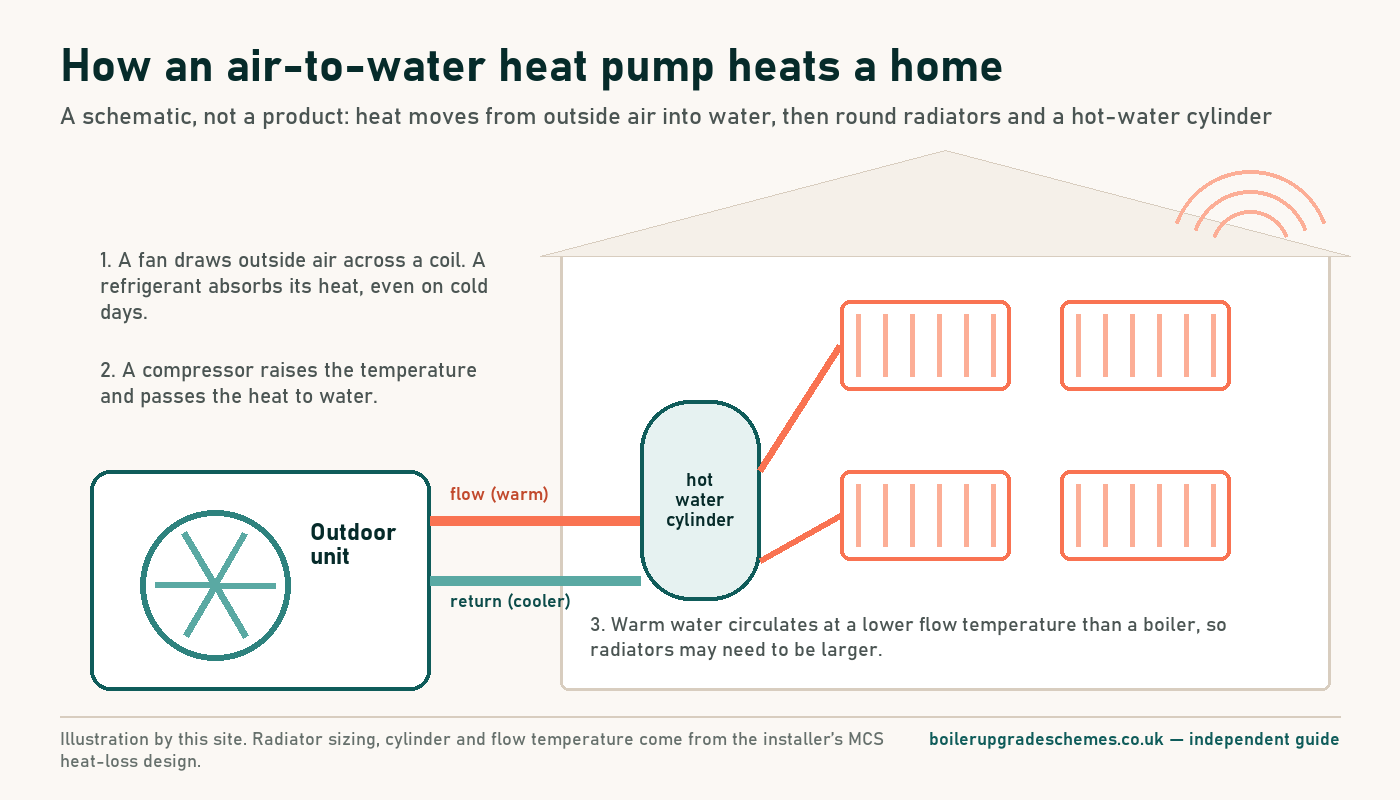
| You need underfloor heating. | Myth | Air-to-water heat pumps heat the water in an ordinary wet central heating system, including radiators. Some radiators may need upsizing because heat pumps run at lower flow temperatures. |
| Air conditioning can never get the grant. | Out of date | Since 28 April 2026, an air-to-air heat pump in a home can get £2,500, if it replaces the existing fossil fuel or electric heating. |
| The scheme is ending soon. | Myth | The published closing date for applications is 30 December 2029, with £400 million budgeted for 2026 to 2027. The date that is close is 31 March 2027, when the £9,000 off-gas band is due to end. |
| Ground source gets a smaller grant than air source. | Myth | Both get £7,500, and both get £9,000 in eligible off-gas oil or LPG homes. |
Do heat pumps work in old houses?
This is the most searched heat pump worry, and the best evidence on it is British. The Electrification of Heat demonstration project, funded by the then Department for Business, Energy and Industrial Strategy and run by Energy Systems Catapult, installed 742 heat pumps across a broad spectrum of housing types and socio-economic groups. Its conclusion, published in December 2021, was that there is no property type or architectural era that is unsuitable for a heat pump.
That does not mean every old house can take a heat pump without work. A solid-walled Victorian terrace loses heat faster than a modern semi, so it needs more heat, which may mean a larger heat pump and larger radiators. The point is that the answer comes from a proper room-by-room heat-loss calculation — which MCS installers must do — rather than from the age of the house. If an installer quotes without surveying, that is a warning sign in itself.
Cold weather
An air source heat pump takes heat from outside air even when it feels cold to us; the Energy Saving Trust describes it transferring heat from the outside air to the water in your central heating system. Efficiency drops as the outdoor temperature falls, which is why the design has to be based on your local winter conditions and why the seasonal figure (SCOP) matters more than any single test-bench number. Ground source systems are less affected, because ground temperature is steadier than air.
Noise
Outdoor units have a fan and a compressor, so they are not silent. In England, the planning system handles this directly: an air source heat pump on a house is only permitted development if it complies with the MCS planning standards, which set a limit of 37.0 dB(A) at the assessment position outside a neighbour’s window or door. Where a position cannot meet that, you need planning permission, and the council will judge it. The old rule requiring a unit to be a metre from the boundary was removed on 29 May 2025. More in planning permission.
Where the sceptics are right
Two points deserve a straight concession. First, running costs: the Energy Saving Trust says that on standard tariffs heat pumps can cost slightly more to run than new gas or oil boilers. Our own illustrative numbers — about £1,053 a year against £1,063 for gas plus the standing charge — say the same thing: roughly level. The saving comes from leaving oil, LPG or direct electric, from a heat-pump tariff, or from removing the gas supply.
Second, installation quality varies. The technology is proven; a poorly designed system is not. Check the installer, insist on a heat-loss survey, and get the design flow temperature and SCOP in writing. Our MCS installer checklist and worth-it guide cover both, and the gas boiler comparison sets the two side by side.
Two more doubts, answered
“I heard heat pumps are unreliable.”
We have not found a robust UK dataset on heat pump failure rates, so we do not quote one. What protects you is the paperwork: an MCS-certified installation, a manufacturer’s warranty on the unit, a workmanship warranty, and a consumer code to go to if the installer does not put things right.
Like any appliance, a heat pump needs servicing. Ask what the manufacturer requires to keep the warranty valid.
“It’s all a way to sell expensive kit.”
The official median installed cost of an air source heat pump is public — £12,908 in 2026 Q2 — so you can test any quote against it. The Energy Saving Trust quotes around £12,000.