Air source heat pumps: the England limits
Permitted development rights let you carry out some work without a planning application. For air source heat pumps on houses and blocks of flats in England, the rights are in Class G of Part 14 of the General Permitted Development Order 2015. An installation is not permitted development if any of these apply:
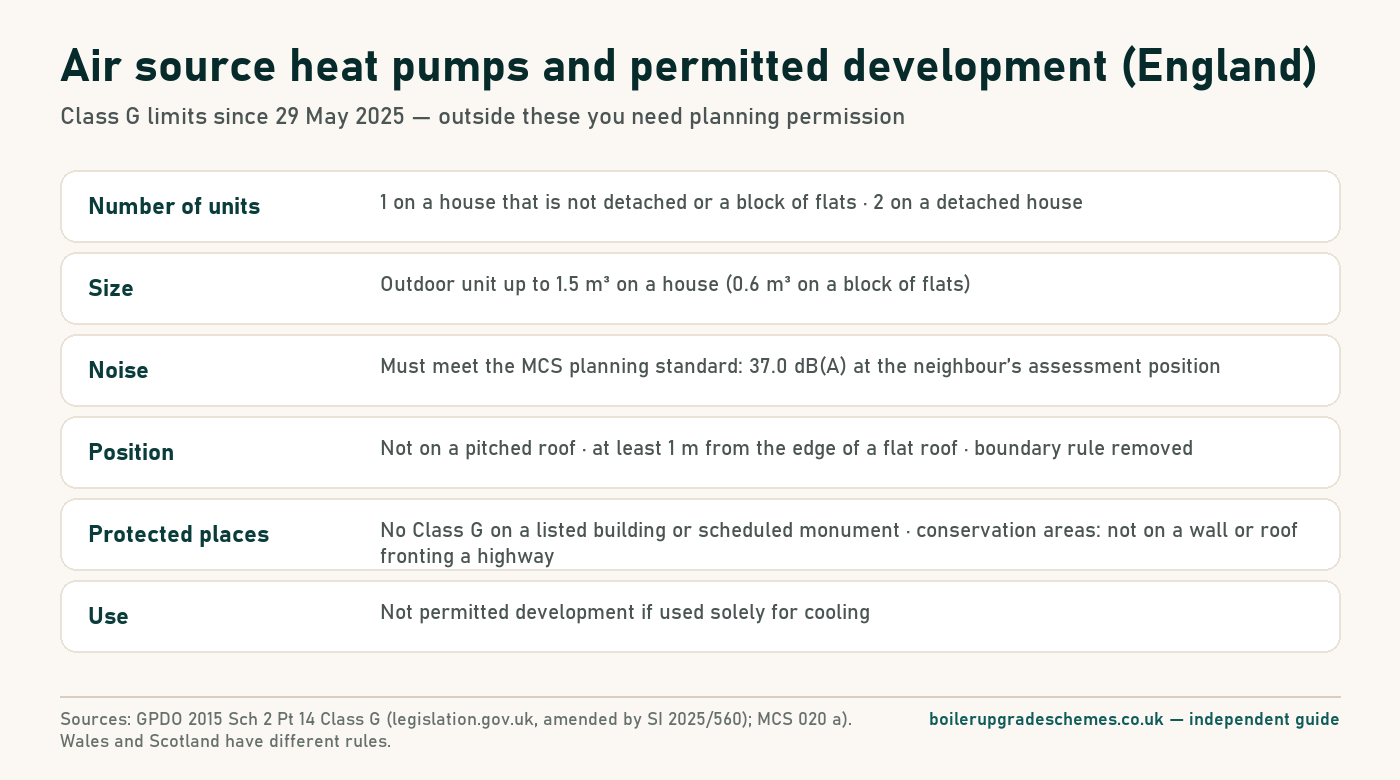
| Condition | The limit |
|---|---|
| Number of units | More than 1 on a house that is not detached, or on a block of flats; more than 2 on a detached house |
| Size of outdoor unit | Over 1.5 cubic metres (including housing) on a house; over 0.6 cubic metres on a block of flats |
| Noise | Does not comply with the MCS Planning Standards — 37.0 dB(A) at the assessment position |
| Roofs | On a pitched roof; or on a flat roof within 1 metre of its edge |
| Wind turbines | A wind turbine on the building or in the curtilage |
| Protected sites | A listed building or its curtilage; a scheduled monument |
| Conservation areas and World Heritage Sites | On a wall or roof fronting a highway, or nearer to a bounding highway than the house |
| Elsewhere | On a wall fronting a highway above ground-floor level |
| Use | Used solely for cooling |
Outside these limits, you need to apply for planning permission. The council may still grant it; the limits only define what is automatically allowed.
What changed on 29 May 2025
Amendments to the order that came into force on 29 May 2025 made three changes worth knowing, because a lot of older advice is still online:
- The one-metre boundary rule went. Units no longer have to be at least a metre from the property boundary to be permitted development.
- Detached houses can have two units, instead of one.
- The size limit rose to 1.5 cubic metres for the outdoor unit on a house.
The noise standard also moved to MCS 020 a), with its 37.0 dB(A) limit. A condition was added that a unit used solely for cooling is not permitted development — which is why a reverse-cycle unit that also heats is treated differently from a cooling-only air conditioner.
Listed buildings, conservation areas and Article 4
If the house is listed, Class G does not apply at all: you need planning permission, and listed building consent if the works affect the building’s character. In a conservation area or World Heritage Site the rights still apply, but not on a wall or roof that fronts a highway, or anywhere nearer to a bounding highway than the house itself. That is a position test, not a visibility test — a unit tucked round the side can still fail it if it is closer to the road than the house.
Councils can also remove permitted development rights in particular areas with an Article 4 direction. If you are in a conservation area, check with the council whether one applies.
The noise assessment
The MCS planning standard sets out how the installer calculates the noise level at the assessment position — broadly, one metre outside the nearest habitable-room window or door of a neighbouring property — taking into account the unit’s sound power, distance and any barriers. If the calculated level is within 37.0 dB(A), the noise condition is met. It is part of a good installer’s design; ask to see the result for your chosen position.
Ground source heat pumps
In England, installing a ground source heat pump at a house is generally permitted development under Part 14 of the order, without the size and noise conditions that apply to air source units. Listed buildings, conservation areas and Article 4 directions can still bring in consent requirements for associated works such as outbuildings for plant, so check if any apply. See ground source cost and grant.
Wales, Scotland and Northern Ireland
Planning is devolved. The Class G limits above are England’s; Wales has its own permitted development order and different conditions, and Scotland and Northern Ireland have separate systems. The Boiler Upgrade Scheme covers England and Wales, so if you are in Wales, ask your installer and the local planning authority which Welsh rules apply to your position. More on the nations in Scotland, Wales and Northern Ireland.
Planning and the grant
The grant does not require planning permission as such, but the installation must be lawful and meet MCS standards, and the installer applies for the voucher before or shortly after the work. Build any permission time into the plan: vouchers last 3 months for air source and 6 for ground source, and the 0% VAT rate on installation runs to 31 March 2027. Check the installer on the MCS register, and see how to apply.
Planning worries
“My neighbour will object, so I can’t have one.”
If the installation is permitted development, there is no application for a neighbour to object to — the limits, including the noise limit at their window, are there to protect them. If you do need permission, the council weighs any objections against planning policy in the normal way.
“The installer will sort out planning.”
Many will check whether the position is permitted development and do the MCS noise assessment, because it is part of the design. But responsibility for having any permission you need rests with the property owner. Ask the installer to confirm in writing which rules they have checked.
For a listed building, get the council’s view before paying a deposit.