The maths in one line
A heat pump’s running cost per kWh of heat is simply the electricity price divided by its seasonal efficiency. A boiler’s is the fuel price divided by its efficiency. Everything else — the tariff, the weather, the house — feeds into one of those two numbers.
At the Ofgem cap for 1 October to 31 December 2026, the GB average Direct Debit unit rate is 26.32p per kWh for electricity and 7.97p for gas, with daily standing charges of 54.83p and 29.68p. Heating oil averaged 109.3p a litre for 1,000 litres on 28 September 2026 (BoilerJuice). Those are the inputs below; your own tariff and region will differ.
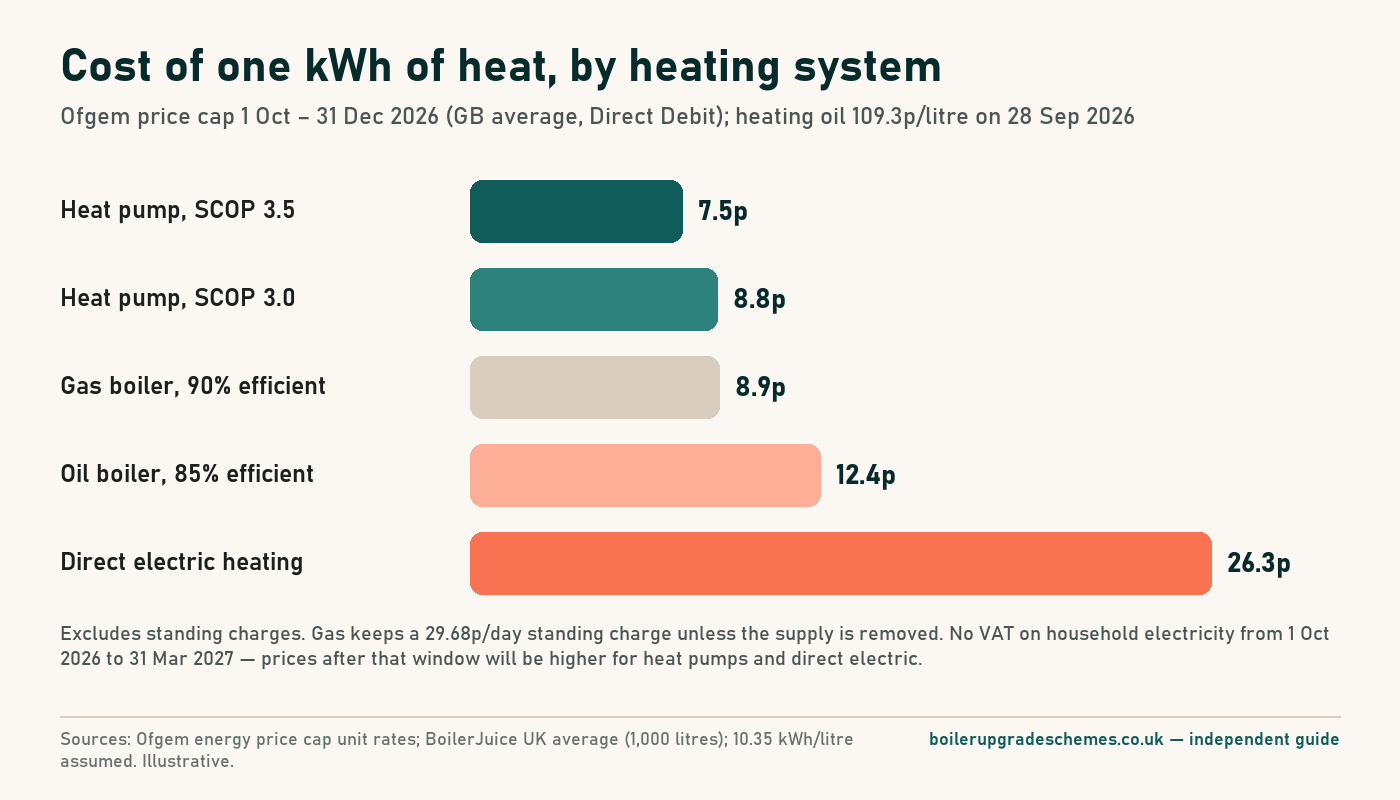
Cost per kWh of heat
| System | Fuel price | Efficiency | Cost per kWh of heat |
|---|---|---|---|
| Heat pump, good design | 26.32p/kWh | SCOP 3.5 | 7.5p |
| Heat pump, typical design | 26.32p/kWh | SCOP 3 | 8.8p |
| Gas boiler | 7.97p/kWh | 90% | 8.9p |
| Oil boiler | 109.3p/litre | 85% | 12.4p |
| Storage or panel heaters | 26.32p/kWh | 100% | 26.3p |
A year of heating: an illustrative example
A home that needs 12,000 kWh of heat a year for space heating and hot water. At the prices above: heat pump at SCOP 3 about £1,053 (at SCOP 3.5, £902); gas boiler about £1,063 plus a £108 gas standing charge if the supply stays; oil about £1,491; storage heaters about £3,158. Electricity standing charges are paid either way, so they cancel out.
The pattern is the headline: roughly level with gas, clearly cheaper than oil, and around a third of the cost of direct electric heating. Use the calculator for your own heat demand — your installer’s heat-loss survey gives the annual figure, and your energy bills give a rough cross-check.
Heat pump running cost calculator
No details needed. Change any figure to match your own quote or bills. Results are indicative — an MCS installer’s heat-loss survey and written quote are what count.
—
Difference per year at these prices.
Prices: Ofgem cap 1 October to 31 December 2026 — electricity 26.32p/kWh, gas 7.97p/kWh, gas standing charge 29.68p/day (GB average, Direct Debit); heating oil 109.3p/litre (BoilerJuice UK average for 1,000 litres, read 28 September 2026); 10.35 kWh per litre assumed. No VAT on household electricity from 1 October 2026 to 31 March 2027, which flatters heat pumps in this window. LPG prices vary too much to default — use your own bills. Illustrative, not a quote.
SCOP: the number that decides it
The seasonal coefficient of performance (SCOP) is the average amount of heat a heat pump delivers per unit of electricity over a heating season. At SCOP 3 one kWh of electricity becomes three of heat; at 3.5, three and a half. The difference between those two designs is about £151 a year in our example.
SCOP falls as the water temperature the heat pump has to produce rises. That is why radiator sizing matters: bigger radiators let the system run at a lower flow temperature, and a lower flow temperature means a higher SCOP. Ask every installer to write down the design flow temperature and the expected SCOP for your house; it is the single most useful number for comparing quotes on running cost.
Tariffs and standing charges
The price cap is only the default. The Energy Saving Trust says that on standard electricity tariffs, where electricity is nearly four times the price of gas, heat pumps can cost slightly more to run than new gas or oil boilers — but that switching to a heat-pump time-of-use tariff can reduce running costs significantly. Tariffs change often, so compare what is available when your system is commissioned rather than relying on any figure printed today.
Standing charges matter too. If you remove the gas supply entirely after switching, you stop paying the gas standing charge — about £108 a year at the current cap. If you keep gas for cooking, you keep paying it.
The zero-VAT window on electricity
From 1 October 2026 to 31 March 2027, household electricity in Great Britain carries no VAT; Ofgem’s cap figures above already reflect that. Gas still carries VAT. So any running-cost comparison made during this window flatters heat pumps and direct electric heating slightly. When the window ends, unless it is extended, electricity prices rise by the VAT and the heat pump advantage narrows. We would plan on the post-window figure.
Keeping running costs down
- Let it run low and steady. Heat pumps are most efficient maintaining a temperature rather than blasting heat for short periods.
- Use weather compensation if your controls have it — it lowers the flow temperature on milder days.
- Insulate where you can. Ofgem’s guidance notes that heat pumps perform best in a well-insulated home.
- Check the tariff once the system is running, and again when your deal ends.
- Ask for a handover that explains the controls; many poor results come from boiler habits.
If you are replacing oil or LPG, the grant is £9,000 rather than £7,500 for applications made by the uplift deadline — see the off-gas grant. For the full cost picture, read the air source heat pump cost after the grant and whether it is worth it.
Running-cost doubts
“My neighbour’s heat pump bills are huge.”
Ask how it was designed and set up. High flow temperatures, undersized radiators, a heat pump sized from the old boiler, or controls left on a boiler-style schedule can all drag the seasonal efficiency down. The same technology, properly designed, performs very differently.
Some early installations were poorly designed. That is exactly why the MCS heat-loss calculation and a written design SCOP matter.
“Electricity is four times the price of gas, so it can never be cheaper.”
Per unit of energy, electricity costs about 3.3 times gas at the current cap. A heat pump turns each kWh of electricity into roughly three kWh of heat, which is why the per-kWh-of-heat cost ends up close to gas rather than four times it.