What a ground source heat pump costs
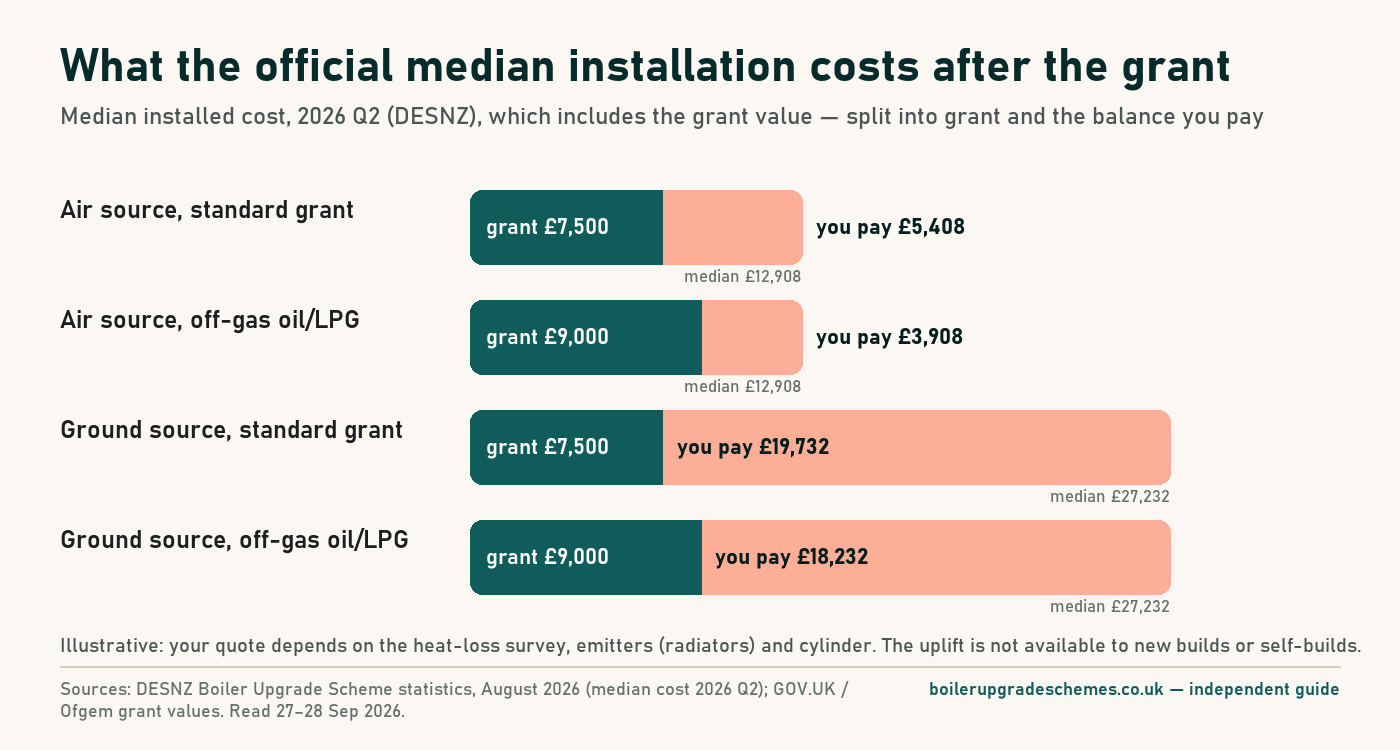
DESNZ publishes the median installed cost of grant-funded ground source systems alongside air source. In 2026 Q2 it was £27,232, including the grant — a little over twice the £12,908 air source median. The Energy Saving Trust gives a lower typical figure of around £15,000 where the ground loop is buried in trenches, and says a borehole costs considerably more. Its list of what moves the price:
- access to the ground, and whether you choose trenches or a borehole for the loop;
- the brand, model and size of heat pump;
- the size of the property and how much heat it needs;
- whether it is a new build or an existing property;
- whether radiators need upgrading or underfloor heating is added.
The spread between those two published figures is itself informative: the median reflects the real mix of grant-funded jobs, which lean towards larger, rural, off-gas properties that often need boreholes or long loops.
The ground source heat pump grant
| Property | Grant | Balance at the median |
|---|---|---|
| Connected to mains gas | £7,500 | £19,732 |
| Off-gas, replacing oil or LPG | £9,000 | £18,232 |
| Off-gas, replacing electric or coal | £7,500 | £19,732 |
The grant is identical to air source. Some sites still claim ground source gets a smaller grant; the published grant categories give both technologies the same amount in every property type. The capacity limit is 45kWth for a single system and 300kWth where properties share a ground loop, which is how some terraces and small developments use the scheme. Installation is zero-rated for VAT in a home until 31 March 2027.
Ground source cost after the grant
No details needed. Change any figure to match your own quote or bills. Results are indicative — an MCS installer’s heat-loss survey and written quote are what count.
£19,732
Payable by you on this quote. The grant is deducted on the quote and invoice — you never receive it as cash.
Default quote = the official median installed cost for 2026 Q2 (DESNZ, published 24 September 2026), which includes the grant value. VAT on installing a heat pump in a home is 0% until 31 March 2027, then 5%.
Trenches or boreholes
A ground source heat pump collects heat through a loop of pipe filled with a water and antifreeze mix. There are two ways to lay it.
Horizontal trenches
The cheaper option where there is land. The Energy Saving Trust suggests that a new-build three-bedroom house would need two trenches of 30 to 40 metres; a larger or older, less well insulated home needs more. The ground must be diggable, reachable by machinery from a road entrance and free of trees, whose roots cause problems.
Vertical boreholes
For limited space. A borehole is only about 20cm wide but typically 75 to 200 metres deep, depending on heat demand and geology, and larger houses may need more than one. It usually needs a specialist thermogeological survey and costs considerably more than trenches — but because the ground is warmer the deeper you go, it can be more efficient.
Who chooses ground source
The statistics show a clear pattern. Of grant-funded ground source systems, 82% were in off-gas properties and 84% in rural areas, against 49% rural for the scheme overall. That fits the economics: a rural house on oil or LPG has the land for a loop, the most expensive fuel to replace and, until 31 March 2027, the higher £9,000 grant.
If you are on mains gas in a town, an air source heat pump will almost always be the cheaper route to the same grant — see air source heat pump cost after the grant.
The six-month voucher
Because ground loops take longer to install, Ofgem gives ground source vouchers a longer life: the installer has 6 months from approval to install, commission and redeem, against 3 months for air source. Groundworks can be weather-dependent, so agree a realistic schedule before the installer applies. The rest of the process is the same — see how to apply.
Planning
In England, installing a ground source heat pump at a house is generally permitted development under Part 14 of the General Permitted Development Order, without the size and noise limits that apply to air source units. Listed buildings, conservation areas and Article 4 directions can still bring in consent requirements for associated works, and Wales and Scotland have their own rules. Our planning permission guide covers both types. For running costs against oil and gas, including heat-pump tariffs, see heat pump running costs.
Paying the balance after the grant
The grant comes off the price before you pay anything, so the question is only how to fund what is left. These are the routes people use — this site does not arrange credit or recommend a lender.
| Route | How it works | What to check |
|---|---|---|
| Savings | Pay the balance on the installer’s payment schedule. You own the system outright. | How much deposit is asked for up front, and whether it is protected under the installer’s consumer code. |
| 0% VAT | Applied by the installer on a supply-and-install job in a home until 31 March 2027; 5% after. | That the quote shows no VAT on the installation. Equipment bought without installation is standard-rated. |
| Mortgage further advance or green home loan | Some lenders offer borrowing earmarked for energy improvements, sometimes at reduced rates. | The representative APR, the total amount repayable and any fees — compare against simply paying from savings. |
| Installer-arranged credit | Some installers introduce a credit broker so the balance is paid monthly. | The lender must be authorised by the Financial Conduct Authority. Ask for the APR and total repayable in writing before you sign anything. |
| Scotland only | Home Energy Scotland offers an interest-free loan of up to £7,500 alongside its own grant (not the Boiler Upgrade Scheme). | Apply to Home Energy Scotland before work starts. |
Is ground source right for you?
“Ground source costs twice as much, so it can’t be worth it.”
The median installed cost is higher — £27,232 against £12,908 for air source in 2026 Q2 — and the grant is the same £7,500 (or £9,000 off-gas on oil or LPG). What you buy for the difference is a heat source that is steadier through winter and no outdoor fan unit. Whether that is worth it depends on land, heat demand and how long you will stay.
For many ordinary homes it is not worth it, and an air source heat pump will do the job for much less. Ground source makes most sense on larger rural properties with space.
“I don’t have a big enough garden.”
You might still have options. Where trench space is limited, a vertical borehole takes only about 20cm of surface width but goes 75 to 200 metres deep, according to the Energy Saving Trust. It costs considerably more and usually needs a ground survey.