Who qualifies for £9,000
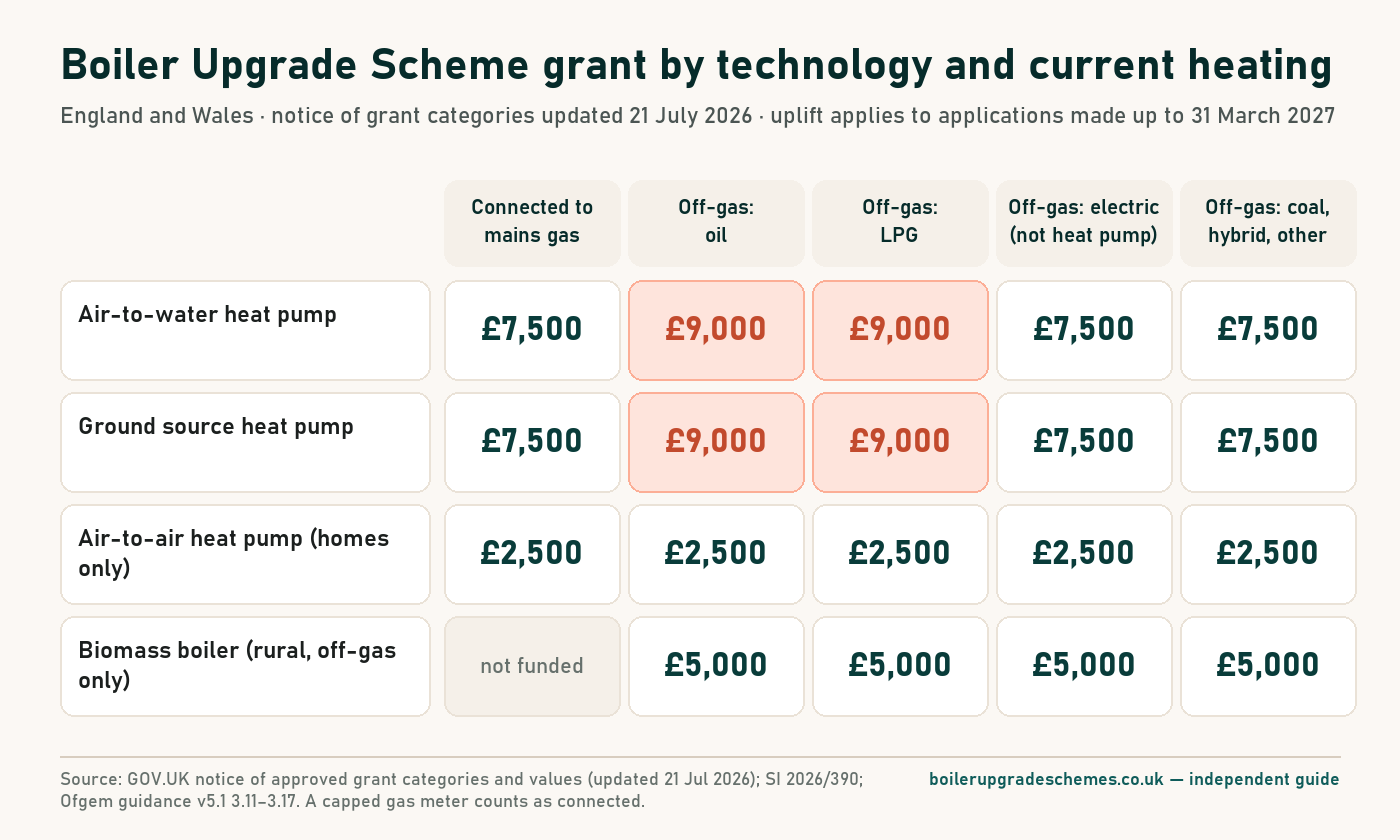
Ofgem’s guidance sets out the uplifted grant in two conditions. From 21 July 2026, £9,000 is available to properties:
- not connected to the gas grid, and
- replacing a heating system fuelled by oil or liquefied petroleum gas (LPG),
with either an air-to-water heat pump or a ground source heat pump. GOV.UK describes the same thing as an additional £1,500 on top of the £7,500, until March 2027, where the property is heated by oil or LPG and has no mains gas connection. Everything else about eligibility is the same as the standard grant: you must own the property in England or Wales, fully replace the old system, and use an MCS-certified installer. See the full eligibility rules.
Ofgem’s definition of “off-gas”
For the scheme, off-gas grid means a property that:
- is not fuelled by mains gas — and capped or clamped gas meter points still count as fuelled by mains gas;
- does not have any record of an existing gas meter point;
- is not attached to a heat network; and
- is not a new-build property.
The second bullet catches people who had gas once and had the supply capped when they switched to oil or LPG. If a meter point is on record, the property is not off-gas for this purpose. The installer must provide evidence that the property meets the test — an EPC can do it, or, where there is none, recent fuel bills or photographs of the existing heating system.
Who does not get £9,000
| Situation | Grant | Why |
|---|---|---|
| Off-gas, replacing oil, air source or ground source | £9,000 | Meets both conditions |
| Off-gas, replacing LPG, air source or ground source | £9,000 | Meets both conditions |
| Off-gas, replacing storage or panel heaters | £7,500, not £9,000 | Electric is not oil or LPG |
| Off-gas, replacing coal or a fossil fuel hybrid | £7,500, not £9,000 | Notice of grant categories |
| Oil-heated, but a capped gas meter on site | £7,500, not £9,000 | A capped meter counts as mains gas |
| Self-build replacing nothing, or a new build | £7,500, not £9,000 | New builds are excluded from off-gas; self-builds from the uplift |
| Oil or LPG to an air-to-air heat pump | £2,500 | The uplift is for air-to-water and ground source only |
| Oil or LPG to biomass | £5,000 | Biomass has its own band |
The dates: applications, not installations
The uplifted value is available for applications properly made between 21 July 2026 and 31 March 2027. What counts is the date the installer’s voucher application is properly made, not the date the heat pump is switched on. Once issued, the voucher gives the installer 3 months to finish an air source job, or 6 months for ground source.
In practice that means the survey, design and quote need to be done in time for the installer to apply on or before 31 March 2027. Installing a heat pump in a home is also zero-rated for VAT until 31 March 2027, so the two dates coincide.
What £9,000 leaves you to pay
Using the government’s own benchmark — the median installed cost of grant-funded jobs in 2026 Q2, which includes the grant — an air source heat pump at £12,908 leaves £3,908 to pay after £9,000, against £5,408 after the standard grant. A ground source system at the median £27,232 leaves £18,232.
A detached rural house heated by kerosene, with no mains gas and no meter point on record, gets a quote at the air source median of £12,908. The grant of £9,000 is deducted on the quote, leaving £3,908. At the prices below, heating 12,000 kWh a year costs about £1,491 with the oil boiler and about £1,053 with the heat pump.
Your quote, your fuel, your numbers
No details needed. Change any figure to match your own quote or bills. Results are indicative — an MCS installer’s heat-loss survey and written quote are what count.
£5,408
Payable by you on this quote. The grant is deducted on the quote and invoice — you never receive it as cash.
Default quote = the official median installed cost for 2026 Q2 (DESNZ, published 24 September 2026), which includes the grant value. VAT on installing a heat pump in a home is 0% until 31 March 2027, then 5%.
—
Difference per year at these prices.
Prices: Ofgem cap 1 October to 31 December 2026 — electricity 26.32p/kWh, gas 7.97p/kWh, gas standing charge 29.68p/day (GB average, Direct Debit); heating oil 109.3p/litre (BoilerJuice UK average for 1,000 litres, read 28 September 2026); 10.35 kWh per litre assumed. No VAT on household electricity from 1 October 2026 to 31 March 2027, which flatters heat pumps in this window. LPG prices vary too much to default — use your own bills. Illustrative, not a quote.
Running cost against oil and LPG
The off-gas case is the strongest in the scheme because the fuel being replaced is expensive per unit of heat. On 28 September 2026, BoilerJuice’s UK average for 1,000 litres of heating oil was 109.3p a litre. Assuming 10.35 kWh per litre and an 85% efficient boiler, that is about 12.4p per kWh of heat. A heat pump with a seasonal efficiency of 3 at the 1 October to 31 December 2026 electricity cap (26.32p/kWh) delivers heat for about 8.8p. LPG prices vary widely by contract, so use your own bills in the calculator.
Two cautions. Electricity carries no VAT for households from 1 October 2026 to 31 March 2027, which flatters any comparison made today. And the heat pump’s seasonal efficiency depends on design — flow temperature, radiator sizes and controls — so ask the installer for their design figure rather than assuming. More in heat pump running costs.
How many people are using it
DESNZ statistics published on 24 September 2026 show 5,351 applications for the uplifted grant in July and August 2026 — 34% of the 15,636 applications in those two months. July 2026 was the busiest month in the scheme’s history with 8,150 applications. Across the life of the scheme, oil has been the fuel replaced in 17% of paid grants and LPG in 3%. The statistics page charts the rest.
If your old system is on its last legs, the practical order is: check the property against the definition above, get two quotes that show £9,000 deducted, and check each installer on the MCS register using our MCS installer checklist.
Paying the balance after the grant
The grant comes off the price before you pay anything, so the question is only how to fund what is left. These are the routes people use — this site does not arrange credit or recommend a lender.
| Route | How it works | What to check |
|---|---|---|
| Savings | Pay the balance on the installer’s payment schedule. You own the system outright. | How much deposit is asked for up front, and whether it is protected under the installer’s consumer code. |
| 0% VAT | Applied by the installer on a supply-and-install job in a home until 31 March 2027; 5% after. | That the quote shows no VAT on the installation. Equipment bought without installation is standard-rated. |
| Mortgage further advance or green home loan | Some lenders offer borrowing earmarked for energy improvements, sometimes at reduced rates. | The representative APR, the total amount repayable and any fees — compare against simply paying from savings. |
| Installer-arranged credit | Some installers introduce a credit broker so the balance is paid monthly. | The lender must be authorised by the Financial Conduct Authority. Ask for the APR and total repayable in writing before you sign anything. |
| Scotland only | Home Energy Scotland offers an interest-free loan of up to £7,500 alongside its own grant (not the Boiler Upgrade Scheme). | Apply to Home Energy Scotland before work starts. |
Questions off-gas households raise
“I’ll wait and see if the higher grant is extended.”
You might be right — nobody knows. But what is published is that the £9,000 band covers applications properly made up to 31 March 2027. After that, the same heat pump attracts £7,500 unless the government announces otherwise. The difference on a single job is £1,500.
Waiting costs nothing if your oil boiler is healthy and you have no plans to change it. The date only matters if you were going to switch anyway.
“My LPG is on a metered supply from the street — am I off-gas?”
Ofgem’s off-gas test is about mains gas: the property must not be fuelled by mains gas, must have no record of a mains gas meter point, and must not be on a heat network. Your installer has to evidence that. If you are unsure whether your supply counts as mains gas or LPG, ask them to check before the quote is finalised.
“Running a heat pump will cost more than oil.”
Not at today’s prices. At 109.3p a litre (28 September 2026) an 85% efficient oil boiler delivers heat for about 12.4p per kWh; a heat pump at a seasonal efficiency of 3 does it for about 8.8p at the 1 October to 31 December 2026 cap.
Oil prices move, and the zero-VAT window on household electricity ends on 31 March 2027. Re-run the numbers with your own bills.