Three layers of protection
Because the Boiler Upgrade Scheme is installer-led, most of your protection comes through the installer’s obligations rather than through a contract with the government.
- MCS certification sets and maintains technical installation and product standards, certifies installers and products, issues the certificate for each completed installation, and investigates standards issues through its certification bodies.
- A consumer code governs how the installer deals with you as a customer. Ofgem’s guidance says installers working with consumers must be members of a consumer code approved by the Secretary of State.
- Ofgem administers the grant: it approves vouchers, checks and audits installations, and pays installers. It can be contacted if your quote does not show the grant deducted.
The three consumer codes
| Code | Full name | Website |
|---|---|---|
| RECC | Renewable Energy Consumer Code | recc.org.uk |
| HIES | Home Insulation & Energy Systems Contractors Scheme | hiesscheme.org.uk |
| MCS | MCS consumer code (approved by the Secretary of State on 1 June 2026) | mcscertified.com |
Before 1 June 2026, installers needed RECC or HIES membership alongside MCS certification. MCS’s own code being approved means an installer can now meet both requirements through MCS. Either way, ask your installer which code they belong to and look them up on that code’s website.
Protect yourself before signing
Most complaints are easier to avoid than to win. Before you sign:
- Check the installer on the MCS register for the exact technology, and confirm Boiler Upgrade Scheme registration. Our checklist takes two minutes.
- Get a written quote that shows the full price, the grant deducted and the balance — Ofgem’s guidance says it must.
- Ask how any deposit is protected, what the payment stages are, and what happens to the price if the grant application is refused.
- Ask what warranty covers the heat pump itself and what covers the workmanship, and for how long.
- Do not sign on the day of a first visit if you feel rushed.
After installation, keep the quote, contract, invoice, proof of payment, the MCS certificate and the commissioning paperwork. Ofgem asks property owners to keep these anyway, in case the installation is audited.
Where to complain, by problem
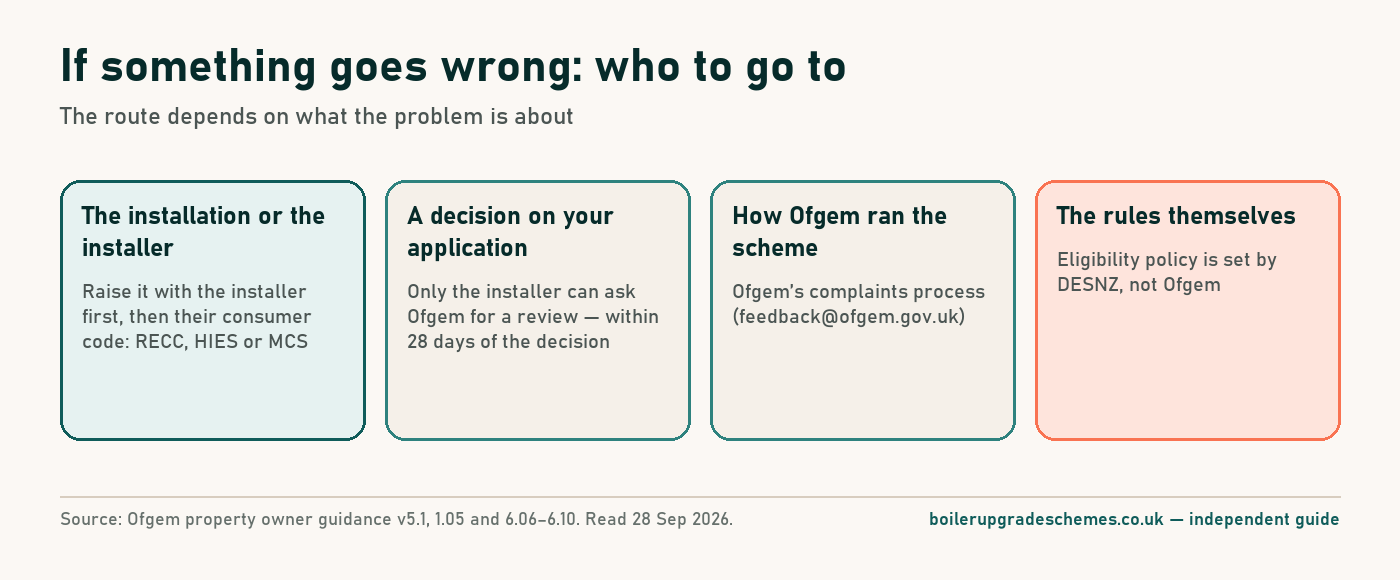
The installation or the installer’s behaviour
Raise it with the installer first, in writing. If it is not resolved, Ofgem’s guidance says you may be able to contact the installer’s consumer code — RECC, HIES or MCS — for further support. Technical standards issues can be taken up through MCS.
A decision on your grant application
The scheme is installer-led, and only installers can ask Ofgem to review a decision. If you disagree with a decision, your installer must request a statutory review on your behalf within 28 days of the notice of the decision.
How Ofgem administered the scheme
Complaints about Ofgem’s administration go to Ofgem through its feedback and complaints process.
The rules themselves
Eligibility criteria and scheme policy are set by the Department for Energy Security and Net Zero, not Ofgem. If your complaint is that the rules are unfair — for example that a property type is excluded — that is a DESNZ matter.
If a grant is refused after work is done
The regulations require the installer to deduct the grant upfront and not to ask you to pay it, unless the application is refused or the voucher revoked. If that happens, whether the installer can ask you for the deducted £7,500 (or £9,000) depends on your contract with them. That is why the contract terms matter — and why applications made before installation, with your consent confirmed, are safer than retrospective ones, which Ofgem says carry additional risk.
Scam warning signs
- A cold call or message claiming to be from “the government boiler upgrade scheme” and offering a free heat pump or boiler.
- Any request for you to pay a fee to “release” or “reserve” the grant. The grant is paid by Ofgem to the installer; you never pay to receive it.
- Pressure to share bank details or identity documents with someone who contacted you first.
- An installer who cannot give you an MCS certification number that checks out.
Ofgem does contact property owners — to confirm consent by email, and sometimes by phone or visit for checks — but only after an installer you chose has applied. If in doubt, contact Ofgem using the details on its own website rather than any number given to you. For the application steps, see how to apply; for eligibility, who qualifies.
Common assumptions about complaints
“Complaining won’t get me anywhere.”
Installers under the scheme have to belong to an approved consumer code, and those codes exist precisely to handle disputes the installer does not resolve. Keep your quote, contract, invoice, proof of payment and the MCS certificate — they are what any complaint route will ask for.
“Ofgem will sort out a bad installation.”
Not usually. Ofgem runs the grant; it is not the body for workmanship disputes. Those go to the installer, then their consumer code, and technical standards issues to MCS through the installer’s certification body.
Ofgem does deal with the grant itself — for example if a quote did not deduct the grant, or with fraud concerns.